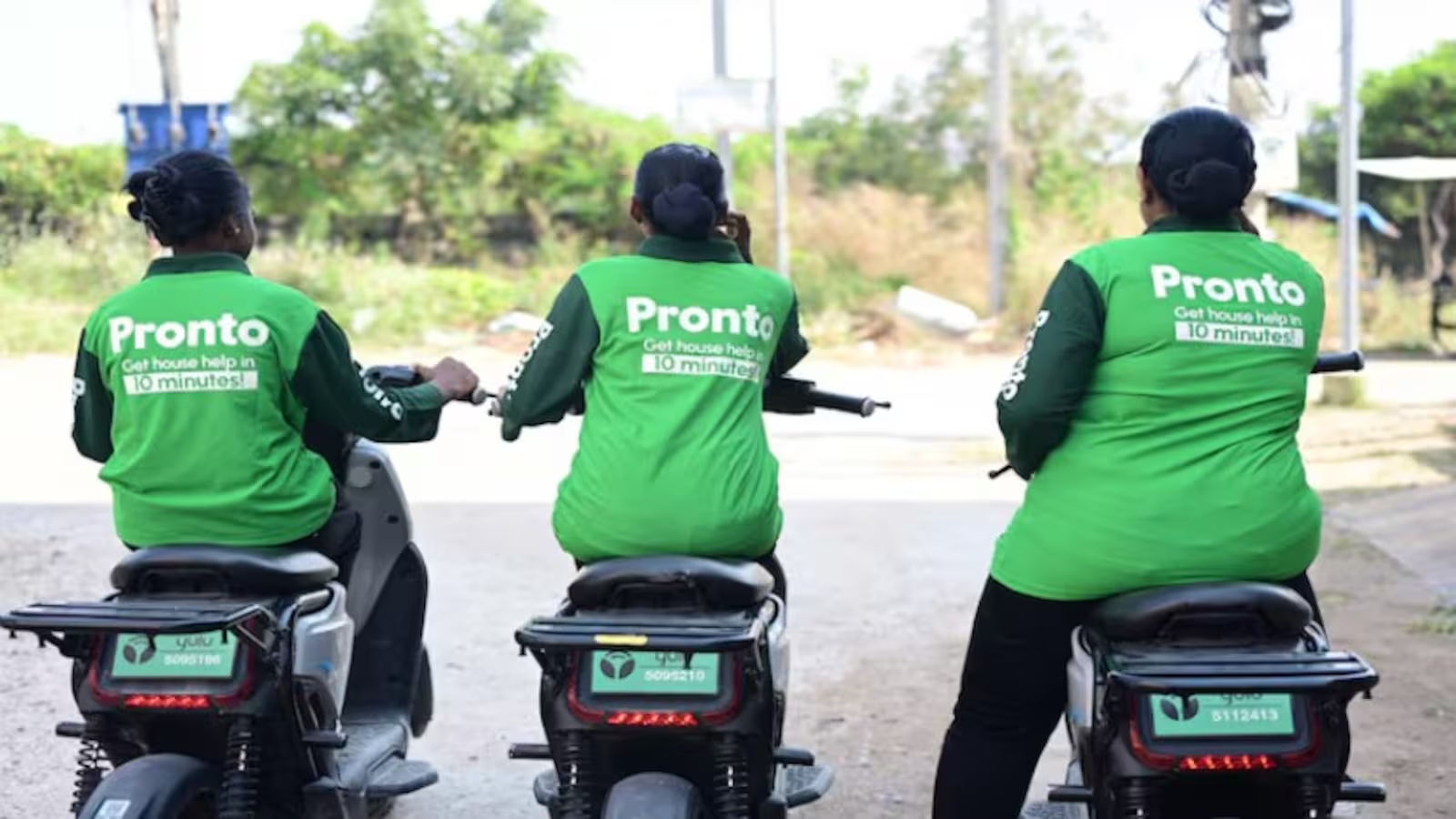
Somewhere inside a modest Gurugram apartment block, a trained domestic worker called a "Pro" arrives to mop floors within ten minutes of a booking. That transaction — mundane on its face — is about to be underwritten by one of Silicon Valley's sharper angel investors. Lachy Groom, known for early bets on Figma and Notion before either became a verb, is finalising a deal to lead a $20 million round in Bengaluru-based Pronto that would peg the startup's post-money valuation at $200 million, according to people familiar with the matter.
That number is striking not for its size — $200 million is a rounding error in a year when OpenAI closed $110 billion — but for its velocity. Pronto raised its Series B at a $100 million valuation in early March, led by Epiq Capital. That was already eight times the $12.5 million valuation it carried when it emerged from stealth in May 2025. Now, less than eight weeks after the Series B closed, the number has doubled again. For a company that did not exist two years ago, that is either a growth story or a warning label — and the answer, most likely, is both.
The growth metrics underneath that valuation are, by any honest reading, extraordinary. Pronto completed roughly 500,000 orders in March. Daily bookings have climbed from about 18,000 at the time of the Series B to somewhere between 24,000 and 25,000 now — a run rate of growth that is faster week-on-week than almost anything you would find in Indian consumer internet at this stage. Founder Anjali Sardana told TechCrunch in March that the platform's top users place nine or more orders a month, and that the median gap between a customer's first and second booking is just two days. That is habitual behaviour, not a novelty spike.
The supply side is equally notable. Pronto's network of professionals has crossed 4,500 active workers, approximately 99% women, earning median monthly incomes of ₹23,000 to ₹25,000 for those completing around 20 shifts a month. Monthly worker retention sits above 70%. In a sector where informal churn is endemic — where the biggest operational nightmare for every household in urban India is the maid who stops showing up — that retention number is probably Pronto's most defensible asset. It is also the thing that is hardest to fake.
The Market Underneath the Hype
India's domestic services sector has been a graveyard for organised players for the better part of a decade. The sector was valued at roughly ₹5,100 to ₹5,210 billion — around $56 to $57 billion — in FY 2025, according to Redseer Strategy Consultants. Online penetration, however, remains below 1% of net transaction value. The reason is not technological; it is social. Hiring domestic help in India runs almost entirely on referrals, caste networks, and neighbourhood trust. "I still believe that 99.99% of this market is completely offline," Sardana told TechCrunch in March. "In aggregate, less than 100,000 people are using a service like this per day, while tens of millions of households rely on offline arrangements."
The Redseer data projects the online segment growing at 18 to 22% compounded annually through FY 2030, driven by rising urban incomes, nuclear family structures, and the kind of convenience-first expectations that quick commerce players like Blinkit have already hard-wired into Indian middle-class behaviour. What Pronto is betting on is essentially a transfer of the quick commerce mental model — near-instant fulfillment, reliability guarantees, app-native ordering — into a service category that involves humans in your home, which is a considerably more trust-intensive proposition than a packet of chips.
Where Groom Fits — and Why It Is Slightly Unusual
This is where things get interesting from an investor-pattern perspective. Lachy Groom built his angel reputation primarily in B2B SaaS and developer tools — Figma, Notion, Formation Bio. The move into an Indian on-demand labour marketplace is a meaningful departure from that archetype. It is not unprecedented — Groom's portfolio has expanded to include Indian companies like Zepto, the quick commerce platform — but backing an early-stage domestic services startup at a $200 million post-money number is a different kind of bet than catching a seed round in a productivity tool.
The interpretation most favourable to Groom is that he sees Pronto's operational stack — its training protocols, background verification, shift assignment, and retention systems — as a kind of logistics infrastructure play: the kind of bottom-up, product-led adoption story that he has backed before, just applied to physical-world labour rather than software seats. The less flattering reading is that a sharp investor looked at the week-on-week order growth and decided the momentum was worth paying for before someone else did. Neither reading is wrong. In practice, they are usually the same decision.
"When valuation compounds faster than revenue, the question isn't whether the business is real — it's whether the capital structure can survive the inevitable quarter where the growth line flattens. India's home services space has seen this before. Pronto's differentiation is on the supply side: if worker retention holds, the unit economics follow. If it doesn't, no amount of investor brand fixes the problem."
— Composite view from observers of India's on-demand labour market, April 2026
The Competition Is Not Resting
Pronto does not operate in a vacuum. Snabbit, its most direct rival, raised $30 million in late October at a $180 million valuation and reported approximately 830,000 orders in February — still ahead of Pronto on raw monthly volume at that snapshot. Urban Company, the publicly listed incumbent, crossed 50,000 daily bookings in February, roughly twice Pronto's current daily number, though Urban Company's service mix is considerably broader and its cost structure accordingly heavier.
Sensor Tower data from March showed Pronto's daily active users growing about 37% in late January to late February — slightly faster than Snabbit's 30% over the same period — but that data point is now several weeks old and the race is compressing fast. The more structurally interesting dynamic is what happens when both Pronto and Snabbit are scaling worker onboarding simultaneously in the same cities, competing for the same pool of domestic workers who are, by Sardana's own admission, already the binding constraint on growth. Demand outpaces supply right now. A funding arms race on the demand side does not obviously help with that.
The Geography Problem Nobody Talks About
Here is the non-obvious observation that tends to get buried in the funding headline: Pronto has expanded to ten cities and more than 150 micromarkets, but the National Capital Region — Delhi NCR — accounts for approximately half of all bookings. That is not a criticism, exactly. NCR is where the affluent nuclear households are, and where quick-commerce habits are most entrenched. But a startup that derives half its volume from one metro is not yet an India story; it is a Delhi story with early outposts. The $200 million valuation prices in a future where Bengaluru, Mumbai, Pune, and Hyderabad all contribute meaningfully. Whether unit economics in those markets ever resemble Gurugram — where Pronto says contribution margins have turned positive in its oldest micromarkets — is the question that will determine whether this valuation holds up in three years or becomes an object lesson in momentum investing.
Founder Perspective
Anjali Sardana's public framing has been consistent and disciplined: quality of service over speed of expansion, supply-side retention as a moat, and a $8 million total burn figure that, if accurate, represents unusual capital efficiency for a company at this valuation. The two-year runway she cited in March now comes with a significant top-up. The test is whether she uses it to deepen existing markets before the pressure to chase vanity metrics in new cities becomes irresistible.
Investor Angle
For Groom, this is a geographic and categorical extension — India's informal-to-formal labour transition is a multi-decade structural trade, and Pronto sits at the earliest organised end of it. The risk is valuation compression if growth normalises before the company reaches profitability in enough markets to justify the number. The prior investors — General Catalyst, Bain Capital Ventures, Glade Brook Capital — are all institutional enough to know that this round's terms are aggressive. Their participation in context signals they believe the floor is defensible.
What Groom's entry does, independent of the capital itself, is change the signal Pronto sends globally. Lachy Groom is not a household name in Mumbai, but in the circuits where the next tier of institutional capital decisions get made — growth equity, crossover funds, pre-IPO desks — his involvement functions as a quality marker. It changes who takes the pitch meeting. That social proof has real economic value, even if it does not show up on a P&L.
The round has not formally closed. Pronto and Groom both declined to comment to TechCrunch, which is standard practice for a deal still in documentation. What is not standard is a company doubling its valuation twice in under two months. Whether Pronto earns that number or spends the next three years growing into it is a question the market will answer — but the signal from the investors still willing to write the cheque is that they think the answer is the former.
Frequently Asked Questions
Q: What is Pronto and how does it work?
Pronto is a Bengaluru-based on-demand domestic services startup that connects households with trained, background-verified professionals for tasks like cleaning, mopping, and utensil washing. The platform promises dispatch within approximately 10 minutes in established micromarkets, positioning it closer to quick commerce than traditional home services companies. Workers, whom Pronto calls "Pros," are assigned structured shifts and undergo in-person training before taking bookings.
Q: Who is leading Pronto's latest funding round and at what valuation?
Tech investor Lachy Groom — known for early-stage bets on Figma and Notion — is finalising a deal to lead a $20 million round in Pronto that would value the company at approximately $200 million post-investment, according to sources cited by TechCrunch. The round has not officially closed and neither Pronto nor Groom has confirmed the terms publicly.
Q: How fast has Pronto's valuation grown?
Pronto's valuation has grown more than 16 times in under a year. It debuted at a $12.5 million valuation in May 2025, reached $45 million by August, hit $100 million with its Series B in March 2026, and is now reportedly finalising a round at $200 million — a doubling in under eight weeks from the Series B close.
Q: Who are Pronto's main competitors in India?
Pronto's closest direct rival is Snabbit, which raised $30 million at a $180 million valuation in late 2025 and reported roughly 830,000 monthly orders in February 2026. Urban Company, the publicly listed incumbent in India's home services market, is a broader competitor that crossed 50,000 daily bookings in February. All three are competing for the same urban household customer and, critically, the same pool of domestic workers.
Q: How many orders does Pronto handle per day?
As of April 2026, Pronto is handling approximately 24,000 to 25,000 orders daily, up from about 18,000 in March 2026 and roughly 1,000 daily bookings a year earlier. The company completed approximately 500,000 total orders in March 2026.
Q: How large is India's domestic services market?
India's overall home services sector was valued at approximately $56 to $57 billion in FY 2025, according to Redseer Strategy Consultants. However, online penetration remains below 1% of net transaction value, meaning the formal, app-based segment is still nascent. The online segment is projected to grow at 18 to 22% compounded annually through FY 2030, driven by urbanisation and rising middle-class incomes.
Q: How much has Pronto raised in total and who are its investors?
Prior to the Lachy Groom round, Pronto had raised approximately $40 million in total funding. Its investor base includes Epiq Capital (Series B lead), Glade Brook Capital, General Catalyst, and Bain Capital Ventures. If the current round closes at reported terms, total funding would reach approximately $60 million.
Sources
Redseer Strategy Consultants — India Home Services Market Sizing, FY 2025