Hyundai's innovative, compact, and cost-effective EV motor design could become a universal solution, reshaping the automotive industry.
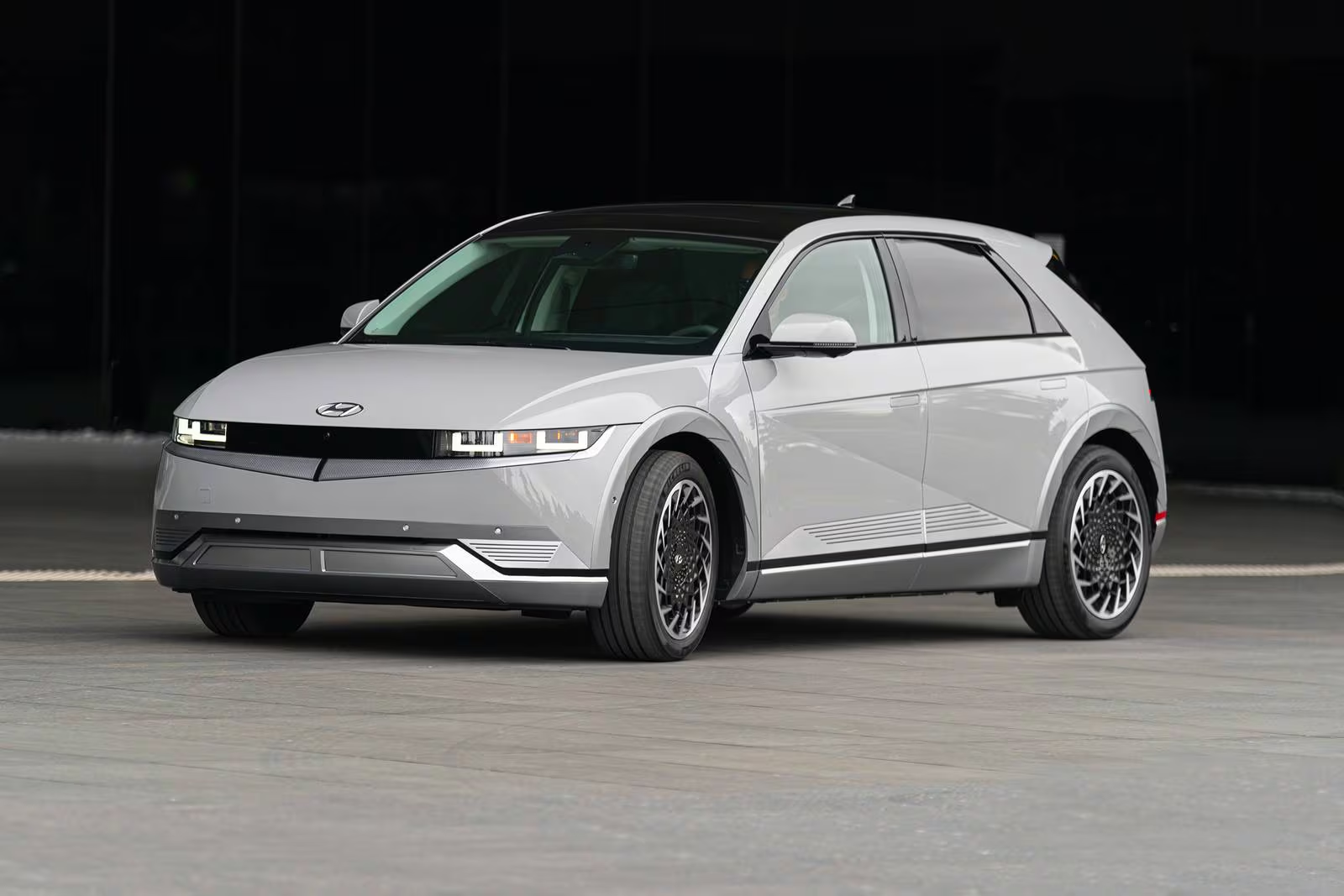
Hyundai has unveiled a new, highly compact and cost-effective electric motor design, positioning it as a potential universal solution for future EVs across its diverse portfolio and possibly beyond. This development, if successful, could significantly alter the competitive landscape for EV powertrain suppliers, forcing a reevaluation of vertical integration strategies across the automotive industry.
For a legacy automaker of Hyundai's global stature, a move like this signals an aggressive push to internalize critical EV components and reduce reliance on external, often expensive, suppliers. The timing is crucial as the entire industry grapples with scaling EV production and driving down the fundamental costs required to reach true mass market adoption.
The company claims its new permanent magnet synchronous motor (PMSM) is up to 30% smaller and 20% cheaper to produce than current market-leading units, while maintaining comparable power density and efficiency characteristics. Hyundai's internal engineering teams reportedly achieved these gains through a combination of innovative winding techniques, improved thermal management, and a simplified manufacturing process that minimizes the use of rare earth magnets, a critical cost driver and supply chain vulnerability.
However, the leap from a compelling prototype to widespread, robust integration across a myriad of vehicle platforms presents substantial engineering and logistical challenges that few OEMs have truly mastered. Past attempts by automakers to standardize core EV components have often faced significant hurdles related to performance optimization for different vehicle classes, from compact city cars to heavy-duty SUVs.
The broader EV market is locked in a fierce, often brutal, race to optimize costs and manufacturing processes, moving decisively beyond the early adopter pricing models. While battery technology typically garners the lion's share of headlines and investment, power electronics and the electric motor itself represent a significant, yet frequently overlooked, portion of an EV’s bill of materials, often accounting for 10-15% of the total powertrain cost.
Hyundai's strategic play here is clear: control the core technology, reduce variable costs, and potentially insulate itself from the volatility of raw material prices, particularly for rare earth elements. This mirrors strategies seen at Tesla, which has long championed its integrated drive units as a competitive advantage in manufacturing efficiency and cost control. Hyundai appears to be learning from, and aggressively countering, the playbook of the EV pioneer.
This motor design, reportedly capable of outputting between 100 kW and 200 kW depending on configuration, suggests a modularity that could span multiple segments, from entry-level electric vehicles to more performance-oriented offerings. The implications for component commonality across Hyundai, Kia, and Genesis brands are immense, promising economies of scale rarely seen outside of internal combustion engine platforms.
The potential for this motor to be "ready to go into any EV" is a bold claim, signaling a highly adaptable architecture. This adaptability would require sophisticated control software and robust thermal management systems that can perform reliably across diverse vehicle masses, aerodynamic profiles, and usage cycles. The real test will be how easily it can be integrated into existing and future platforms without requiring extensive re-engineering of the surrounding vehicle architecture.
From a competitive standpoint, this development puts significant pressure on Tier 1 automotive suppliers like Bosch, ZF, and Magna, which have traditionally provided modular electric drive units to OEMs. If Hyundai can successfully mass-produce this motor internally at the claimed cost points, it could erode a substantial portion of the market for external powertrain solutions, forcing these suppliers to innovate faster or risk losing market share.
The move also underscores a growing trend among leading automakers to bring more critical EV technology in-house, viewing it as a core competency rather than an outsourced component. This vertical integration strategy is a capital-intensive gamble, requiring massive investments in R&D, manufacturing facilities, and specialized talent, but the long-term payoff in terms of intellectual property control and cost reduction could be transformative.
Founders in the EV component space should take note: the bar for innovation is continually rising, and the market for generalized, off-the-shelf solutions may be shrinking as OEMs become more self-sufficient. Startups will need to focus on highly specialized niches, advanced materials, or disruptive manufacturing processes that even global giants struggle to replicate internally.
The cost savings, if realized, could directly translate into more affordable EVs for consumers, a critical factor in accelerating global EV adoption. A 20% reduction in motor cost, when combined with similar efficiencies in battery and power electronics, chips away at the EV premium, making these vehicles accessible to a broader demographic and potentially expanding the total addressable market.
However, the environmental footprint of producing such a motor, especially concerning the sourcing and processing of raw materials, will be under intense scrutiny. While Hyundai claims reduced rare earth usage, the overall sustainability of its manufacturing process and supply chain transparency will be crucial in a market increasingly sensitive to ethical sourcing and circular economy principles.
Venture capitalists backing automotive tech should keenly observe how this internal development impacts the landscape for external suppliers and new entrants. Investment opportunities might shift towards software-defined vehicle architectures, advanced manufacturing automation, or novel materials science that complements, rather than directly competes with, these integrated OEM solutions.
This isn't just about a new motor; it's about Hyundai's long-term vision for EV dominance, leveraging its manufacturing prowess to build a distinct competitive moat. If they pull it off, the industry will have yet another benchmark for cost-efficiency and integration, further intensifying the already cutthroat race to electrify the global automotive fleet.
The true measure of this innovation will lie in its real-world deployment and the sustained cost advantages it delivers across millions of vehicles, setting a new standard for what it means to build a truly scalable, profitable electric vehicle platform.
Frequently asked questions
What is significant about Hyundai's new electric motor?
Hyundai has introduced a new electric motor that is notably smaller and cheaper than existing designs. This innovation aims to be a universal solution for various EV models, potentially lowering production costs and accelerating EV adoption across its lineup and beyond.
How will Hyundai's new motor impact EV costs?
The motor's cost-effective design is expected to significantly reduce the overall production cost of electric vehicles, making them more affordable for consumers.
Can this motor be used in all Hyundai EVs?
Yes, the design is positioned as a potential universal solution, capable of integration across Hyundai's diverse portfolio of electric vehicles.
How does this motor compare in size to current EV motors?
Hyundai's new motor is described as highly compact, implying it's significantly smaller than many current electric motor designs, allowing for more flexible vehicle packaging.
What impact could this have on EV powertrain suppliers?
This development could significantly alter the competitive landscape for EV powertrain suppliers, potentially forcing a reevaluation of their vertical integration strategies.
Is this new motor ready for production?
The article states the motor is 'Ready To Go Into Any EV,' suggesting it is past the conceptual stage and prepared for implementation into upcoming models.