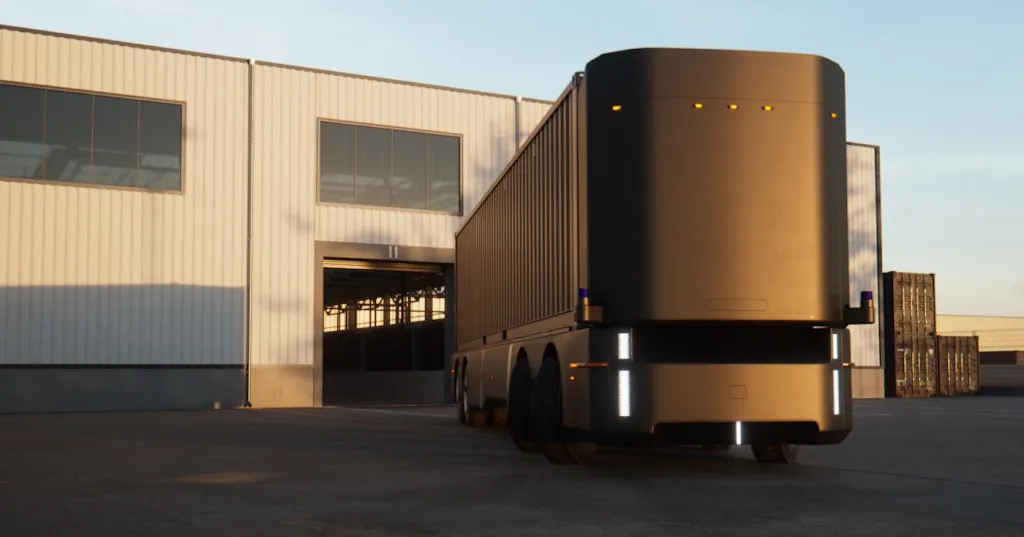
Operating costs consume a substantial portion of revenue for trucking firms, with fuel and driver wages often comprising 60-70% of total expenses. The American Trucking Associations projects a deficit of 160,000 drivers by 2030 in the United States alone. These stark figures underscore the immense pressure on a global logistics sector valued in the trillions. Enter Humble Hauler, an innovation poised to fundamentally redefine freight transport by removing the very element its name suggests: the traditional truck, or at least its human-driven cab, from significant segments of the journey.
Humble Hauler introduces the autonomous trailer, a self-propelled, intelligent freight unit designed to operate independently or in conjunction with a conventional prime mover. This represents a radical departure from current autonomous trucking initiatives, which primarily focus on automating the tractor unit. By shifting autonomy to the trailer itself, Humble Hauler proposes a modular, flexible, and potentially more rapidly deployable solution to some of the industry's most intractable challenges.
The Problem Space: An Industry Under Strain
The global road freight industry is simultaneously indispensable and unsustainable in its current form. Approximately 72% of all freight in the US is transported by truck, generating over $875 billion in revenue in 2021. Yet, this vital sector faces escalating operational pressures. Fuel costs, volatile and significant, can represent 25-35% of a fleet's budget. Driver compensation and benefits, now averaging over $60,000 annually for long-haul drivers, account for another 35-45% of total operating expenses.
Beyond economics, the environmental footprint is substantial. Road freight contributes approximately 8% of global CO2 emissions, equating to roughly 2.5 billion tons annually. Demand for freight continues to grow, particularly with the proliferation of e-commerce, exacerbating both the economic and environmental strains on existing infrastructure and labor pools.
The persistent driver shortage, a global phenomenon impacting North America, Europe, and parts of Asia, restricts capacity and drives up costs. Companies struggle to meet shipping demands, leading to delays and inefficiencies across supply chains. This confluence of economic, environmental, and human resource challenges creates a compelling imperative for disruptive innovation.
Humble Hauler's Core Proposition: Decoupling Power and Payload
The Humble Hauler autonomous trailer is engineered to address these challenges head-on. At its core, the technology involves equipping a standard trailer chassis with an electric powertrain, sensor suite (Lidar, radar, cameras), GPS, and an AI-driven autonomous driving system. This transforms a passive freight container into an active, intelligent vehicle capable of self-locomotion.
Key applications include port drayage, inter-facility transfers within large logistics hubs, and potentially short-to-medium haul routes on designated corridors. In these scenarios, a Humble Hauler unit could autonomously move from a port terminal to a distribution center, or between two warehouses, without requiring a human-driven truck. For longer hauls, a prime mover could tow multiple autonomous trailers in an electronically tethered platoon, with the lead trailer or truck managing the overall driving, and the subsequent trailers using their own power for assistance and braking.
Projected Savings:
Up to 40% reduction in labor costs for specific routes.
10-15% improvement in fuel efficiency for prime movers in platooning scenarios.
Significant reduction in maintenance costs for traditional tractor units on certain routes.
Economic Impact and Operational Efficiency
The economic benefits for founders and operators are multifaceted. The most immediate impact is on labor costs. By eliminating the need for a driver on specific, often repetitive routes, companies can reallocate human resources to more complex or customer-facing tasks. Consider port operations where trailers move continuously within a confined, geofenced environment; automating these movements offers direct, quantifiable savings.
Fuel efficiency also sees substantial gains. An electric autonomous trailer can employ regenerative braking, converting kinetic energy back into electrical power, especially valuable in stop-and-go urban or port environments. When platooning, the autonomous trailers can use their own propulsion to reduce the drag and workload on the lead prime mover, leading to an estimated 10-15% improvement in fuel economy for the entire convoy, even for diesel trucks. This also extends the range of electric prime movers by effectively sharing the propulsion burden.
Furthermore, asset utilization improves dramatically. Autonomous trailers are not subject to hours-of-service regulations, allowing for 24/7 operation. This means trailers can be moved during off-peak hours, reducing congestion and accelerating throughput. For logistics companies, this translates to faster delivery times, reduced detention fees, and higher overall operational velocity.
Beyond Cost: Environmental and Safety Dividends
The environmental advantages of Humble Hauler are significant. The electric powertrain eliminates tailpipe emissions from the trailer itself, contributing directly to decarbonization goals. When combined with renewable energy sources for charging, the carbon footprint of freight movement can be drastically reduced. This aligns with increasing regulatory pressures and corporate sustainability mandates across Europe and North America.
Safety is another critical dimension. Human error accounts for over 90% of all road accidents. Autonomous systems, with their constant vigilance, 360-degree awareness, and rapid reaction times, promise a substantial reduction in collision rates. Advanced sensor fusion and predictive AI can anticipate hazards far more effectively than a fatigued or distracted human driver, leading to safer roads for everyone. This can also lead to reduced insurance premiums for operators over time, albeit after initial regulatory hurdles are cleared.
“The strategic decoupling of trailer and prime mover, powered by robust autonomous systems, represents a paradigm shift. It transforms the concept of 'last mile' and 'first mile' logistics into a highly flexible, modular system. We anticipate significant capital expenditure reallocations and a profound re-evaluation of network design as these units become prevalent.”
Dr. Anya Sharma, Professor of Supply Chain Management, Imperial College London
Navigating the Regulatory and Infrastructural Maze
Despite its promise, the path to widespread adoption for Humble Hauler is not without obstacles. Regulatory frameworks for autonomous vehicles are still evolving, particularly at the state and national levels within the US, and across diverse member states in the EU. Standardizing operational parameters, liability in the event of an accident, and certification processes for autonomous trailers will require significant collaboration between industry, government, and safety organizations.
Infrastructure is another key consideration. While electric trailers reduce reliance on fuel, they introduce a demand for robust charging infrastructure at depots, ports, and logistics hubs. This requires substantial investment and strategic planning. Connectivity for vehicle-to-infrastructure (V2I) and vehicle-to-vehicle (V2V) communication is also crucial for safe and efficient operation, especially in platooning scenarios.
Global Horizons: Adoption and Adaptation
The potential for Humble Hauler is global, but adoption patterns may vary by region. North America, with its vast distances and acute driver shortages, presents a compelling market for hub-to-hub and port drayage applications. Europe, with its dense urban centers and emphasis on environmental regulations, could see rapid adoption in intra-city logistics and dedicated freight corridors. Asia, particularly China and India, with their rapidly expanding logistics sectors and significant investment in smart infrastructure, could become a leading ground for scaling this technology, especially in high-volume manufacturing and distribution zones.
Each region will present unique challenges and opportunities. For instance, varying road conditions, climate extremes, and local traffic behaviors will require adaptation of the autonomous driving algorithms. Localized manufacturing and service networks will also be essential for market penetration and sustained operations.
The Road Ahead: Integration and Disruption
Humble Hauler is not merely an incremental improvement; it is a foundational shift. It transforms the trailer from a passive commodity into an intelligent asset, capable of autonomous action. This capability allows for more dynamic routing, optimized loading, and real-time inventory tracking, blurring the lines between transportation and warehousing.
Founders and operators should view this technology not just as a cost-saving measure, but as an enabler for entirely new business models. Imagine "trailer-as-a-service" where a logistics firm subscribes to autonomous trailer capacity on demand, or integrated smart-city logistics where autonomous trailers manage last-mile deliveries from urban micro-hubs. The implications extend far beyond simple freight movement, promising a more resilient, efficient, and sustainable global supply chain.
KEY TAKEAWAYS
Humble Hauler addresses critical industry challenges: driver shortages, escalating operational costs, and environmental impact, by making trailers autonomous.
The technology promises significant economic benefits through reduced labor and fuel costs, alongside improved asset utilization and 24/7 operational capability.
Environmental benefits include zero tailpipe emissions from electric autonomous trailers and enhanced fuel efficiency for prime movers through platooning. Safety is also significantly enhanced.
Widespread adoption requires overcoming substantial regulatory hurdles and investing in new charging and communication infrastructure across diverse global regions.
Humble Hauler represents a disruptive force, enabling new business models and transforming trailers into intelligent, active participants in the global supply chain.
Frequently asked questions
What is the Humble Hauler autonomous trailer?
The Humble Hauler is an innovative self-driving trailer designed to operate without a traditional truck cab, aiming to reduce operating costs and alleviate the ongoing driver shortage in the trucking industry.
How does Humble Hauler address driver shortages?
By enabling trailers to operate autonomously, Humble Hauler significantly reduces the reliance on human drivers, directly combating the projected deficit of 160,000 drivers by 2030.
What are the main benefits of autonomous trailers for trucking firms?
Autonomous trailers like Humble Hauler primarily offer benefits such as reduced fuel and driver wage costs, increased operational efficiency, and a solution to the persistent driver shortage.
How significant are operating costs in the trucking industry?
Operating costs, particularly fuel and driver wages, typically account for 60-70% of a trucking firm's total expenses, highlighting the immense financial pressure on the sector.
When is Humble Hauler expected to impact the logistics sector?
While the preview introduces Humble Hauler as an innovation, specific timelines for its widespread impact aren't provided. It's poised to address current and future challenges in the trillion-dollar global logistics sector.
What problems does Humble Hauler solve in the logistics sector?
Humble Hauler aims to solve critical problems in logistics, including high operating costs, a severe shortage of truck drivers, and the need for greater efficiency in the global supply chain.