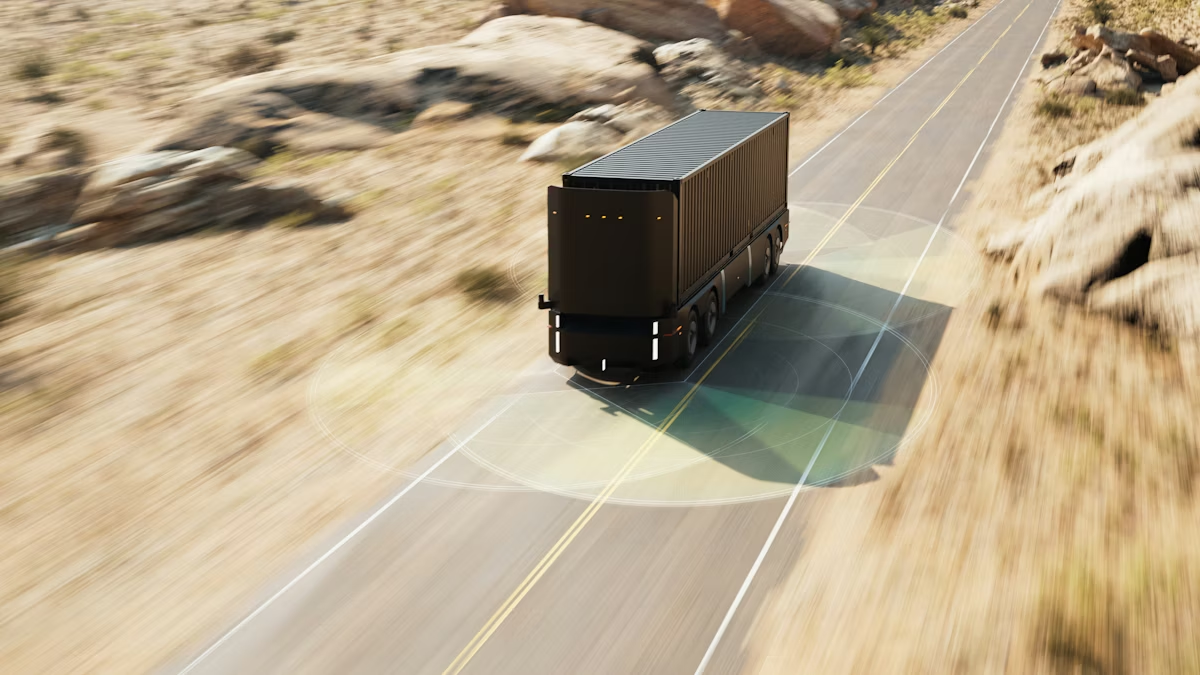
Why Remove the Cab?
Most autonomous truck developers retain a driver cabin, even if human oversight is minimal. The Humble Hauler takes a different approach by removing the cabin altogether.
Eliminating the cab reduces manufacturing complexity, lowers weight and increases cargo capacity efficiency. It also signals that the vehicle is not intended for mixed urban driving environments.
Instead, the Hauler appears optimized for:
Port operations
Industrial campuses
Distribution hubs
Fixed-route freight corridors
In these settings, road unpredictability is lower and operational economics favor automation.
200 Miles: A Strategic Range
A 200-mile range may not compete with long-haul diesel rigs, but it aligns with many regional and last-mile freight cycles.
Short-haul logistics often operate within defined daily loops. Electric charging infrastructure is easier to manage within depots and private facilities.
By focusing on medium-range operations, the Hauler sidesteps one of the biggest hurdles in heavy-duty electrification: ultra-long battery endurance.
Range, in this case, is calibrated to operational reality rather than headline competition.
Automation Meets Cost Pressure
Freight operators face rising labor costs, driver shortages and regulatory constraints on working hours.
Autonomous trucks promise 24/7 operation without rest cycles. In closed-loop environments, the return on investment can be clearer than in consumer-facing autonomy.
A cab-less truck also eliminates driver safety requirements such as seating, climate control and manual controls, potentially lowering production and maintenance costs.
For fleet operators, that could translate into lower cost per mile.
Competitive Landscape
Autonomous trucking is crowded, but strategies vary.
Some companies are targeting highway autonomy with driver-assist systems transitioning to full autonomy. Others, like the Humble Hauler’s creators, are prioritizing industrial or semi-private environments.
The latter path may prove commercially viable sooner, given regulatory simplicity and controlled variables.
Freight corridors within ports and warehouses represent lower-risk automation zones.
The Broader Shift in Logistics
E-commerce growth and just-in-time manufacturing have intensified pressure on logistics networks.
Electrification and automation are converging trends. Electric drivetrains reduce emissions and operating costs, while autonomy tackles labor bottlenecks.
Cab-less designs push that convergence further by rethinking what a “truck” needs to be when no human sits inside.
What It Signals
The Humble Hauler is less about futuristic highways and more about practical deployment.
By limiting its operational scope and optimizing for controlled routes, it reflects a maturing philosophy in autonomous mobility: solve specific use cases first.
If freight automation scales through industrial environments before public roads, vehicles like the Humble Hauler could become common in logistics yards long before fully autonomous cars dominate cities.
In transport innovation, humility may prove strategic.
And sometimes, removing the driver’s seat is the clearest signal of where autonomy is headed.