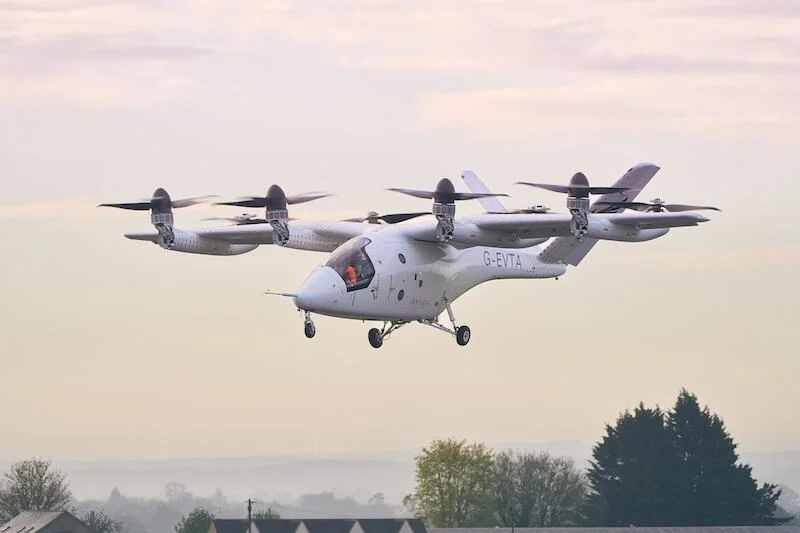
The achievement marks one of the most technically demanding milestones in the certification journey for electric vertical takeoff and landing (eVTOL) aircraft.
Why transition flight matters
In eVTOL design, vertical lift and forward cruise operate under different aerodynamic principles.
Hover mode relies on rotor-driven lift. Wing-borne cruise requires aerodynamic lift from fixed wings while transitioning propulsion systems accordingly.
The handoff between these modes — particularly in reverse during descent — has historically presented stability and control challenges.
Completing a full two-way transition demonstrates that the aircraft’s control systems, propulsion integration and structural design can handle the shift safely in both directions.
For regulators and investors, that capability is critical.
Certification pathway gains momentum
The VX4 is designed as a four-passenger electric aircraft aimed at urban and regional air mobility markets.
Transition flight testing is a prerequisite step toward broader certification efforts with aviation authorities.
Although commercial launch timelines remain subject to regulatory review, demonstrating stable transition strengthens Vertical Aerospace’s case as it moves through flight test phases.
The eVTOL industry has faced scrutiny over ambitious timelines and capital intensity. Tangible flight milestones help differentiate programs with operational progress from those still in prototype development.
Competitive landscape
Vertical Aerospace operates in a crowded advanced air mobility field alongside companies including Joby Aviation, Archer Aviation and Lilium.
While several competitors have demonstrated forward flight, two-way transition remains a key validation point.
Certification remains the primary gating factor for commercialization. Aviation regulators apply standards comparable to traditional aircraft certification, requiring extensive data, redundancy validation and safety documentation.
Demonstrating controlled transition flight narrows technical uncertainty — but commercial viability still depends on production scalability, battery energy density and regulatory approvals.
Infrastructure and market implications
Urban air mobility proponents envision eVTOL aircraft serving:
• Airport shuttle routes
• Intra-city commuting corridors
• Regional short-haul transport
• Premium mobility services
However, operational success requires more than aircraft performance. Charging infrastructure, vertiport networks and air traffic integration remain under development.
The VX4 milestone strengthens Vertical Aerospace’s technical credibility at a time when investor expectations have grown more measured.
Capital markets have become more selective about aerospace startups, favoring demonstrable engineering progress over conceptual roadmaps.
Broader significance for advanced mobility
The eVTOL sector has often been compared to early electric vehicle development — capital intensive, technologically ambitious and reliant on regulatory coordination.
Successful two-way transition indicates that distributed electric propulsion systems can manage complex flight envelopes with increasing reliability.
For aerospace engineers and advanced mobility investors, the milestone suggests the industry is moving beyond static hover tests toward real-world operational profiles.
What comes next
Transition flight is a major step — but not the final one.
Vertical Aerospace must continue accumulating flight hours, refining performance envelopes and advancing certification documentation.
Production scaling and supply chain readiness will follow regulatory clearance.
Still, the successful two-way transition of the VX4 represents a tangible inflection point.
In an industry defined by engineering thresholds, mastering transition flight signals that electric air mobility is progressing from theoretical promise toward operational reality.