Amazon's Zoox robotaxis roll out in expanded zones across Las Vegas and San Francisco, pushing autonomous ambition to public roads.
Zoox Robotaxi Expands in Las Vegas and San Francisco: Amazon's Autonomous Ambition Hits Public Roads Amid Industry Headwinds
Zoox, Amazon's highly capitalized autonomous vehicle subsidiary, has significantly broadened the operational scope of its robotaxi service, now ferrying employees across larger, more complex operational design domains in Las Vegas and San Francisco. This expansion signals a critical acceleration in the company's long-term strategy, pushing its purpose-built vehicles into more demanding urban environments.
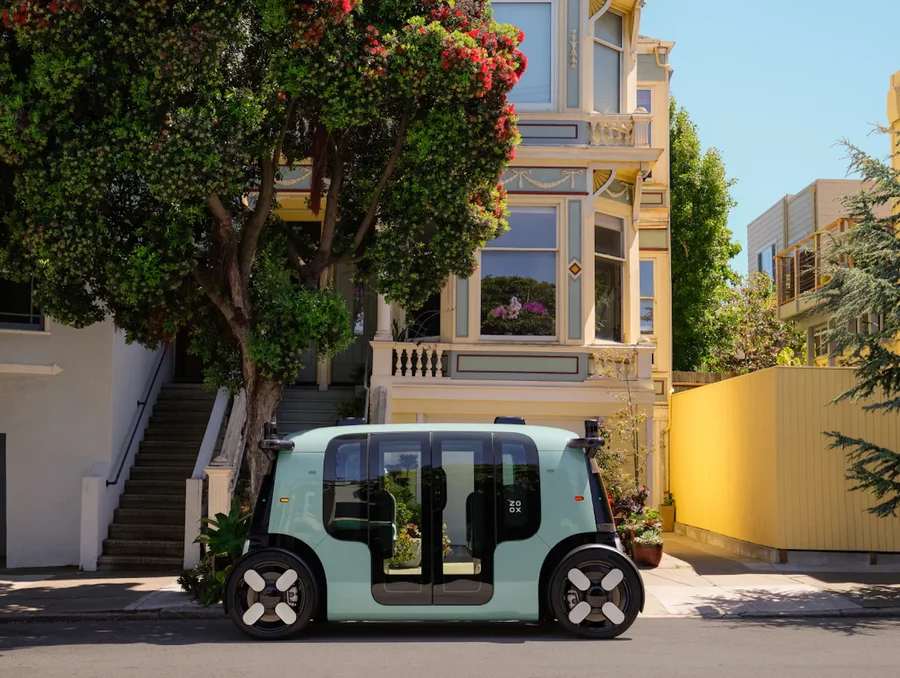
For years, Zoox has been a formidable, if somewhat guarded, player in the fiercely competitive autonomous driving sector, distinguishing itself with a bespoke, bidirectional robotaxi designed from the ground up without traditional driver controls. This move out of more constrained testing areas into expanded zones marks a crucial phase for the company, testing its technology's resilience and scalability in two of North America's most challenging urban landscapes.
The company confirmed that its custom-built vehicles, which lack a steering wheel or pedals, are now actively operating on public roads within specific, enlarged territories in both cities, transporting employees as part of its ongoing validation process. This includes navigating the intricate, densely packed tourist corridors around the Las Vegas Strip and tackling the steep hills and unpredictable traffic patterns of downtown San Francisco, representing a notable leap from previous, smaller-scale trials.
Yet, for all the clear technical progress, the road to widespread commercial viability for Level 4 autonomous services remains notoriously fraught with regulatory scrutiny, persistent public skepticism, and the staggering operational costs that have hampered many of its rivals. Industry veterans know that moving from employee-only rides to a profitable public service is a chasm few have truly bridged.
The broader robotaxi industry, particularly in North America, is currently navigating a period of intense examination following high-profile incidents involving competitors like Cruise, leading to a climate of heightened regulatory caution and a more discerning public eye. Zoox's expansion, therefore, comes at a pivotal moment where flawless execution and demonstrable safety are not just desirable, but absolutely imperative for maintaining momentum and credibility.
Zoox's approach has always been predicated on controlling the entire stack, from hardware design to software, a stark contrast to many peers who integrate third-party components. This end-to-end philosophy, while capital-intensive, is touted internally as the key to superior safety and performance, allowing for deep optimization and redundant systems built into every layer of the robotaxi's operation.
The operational design domains (ODDs) in Las Vegas now reportedly encompass several square miles, moving beyond initial, highly constrained loops. This includes areas with complex intersections, variable speed limits, and significant pedestrian activity, pushing the autonomous driving system to handle a broader spectrum of real-world scenarios that demand sophisticated perception and prediction capabilities.
Similarly, the San Francisco expansion zones are not for the faint of heart, covering parts of the financial district and other areas known for their dynamic and often chaotic traffic conditions. The constant presence of construction, double-parked vehicles, and manual human drivers making unpredictable maneuvers presents a continuous challenge for any autonomous system, let alone one operating a vehicle designed solely for self-driving.
Amazon's strategic acquisition of Zoox in 2020 injected significant capital and a long runway into the company, insulating it somewhat from the immediate pressures faced by venture-backed startups. However, even with Amazon's backing, the demand for a clear path to return on investment for such a substantial bet looms large over the autonomous vehicle sector.
The regulatory environment in both Nevada and California has been cautiously supportive, providing necessary permits for testing and, in some cases, limited driverless operations. However, recent events involving other robotaxi operators have prompted a re-evaluation by state authorities, adding an additional layer of complexity and potential delay to any future commercial deployment.
Zoox's unique vehicle form factor – a symmetrical, bidirectional machine that can travel in either direction without turning around – theoretically offers advantages in navigating tight urban spaces and improving passenger convenience. This design choice, however, also introduces new engineering challenges, particularly in how the vehicle communicates its intentions to human road users.
The company emphasizes its rigorous safety protocols, which include extensive simulation testing, structured closed-course evaluations, and a safety driver present during the early phases of ODD expansion, transitioning to remote oversight once sufficient confidence is built. This multi-layered approach aims to minimize risk, but the sheer unpredictability of urban environments means no system is entirely foolproof.
Competitors like Waymo continue to lead in terms of public deployment mileage and operational hours, while others like Cruise are working to regain trust and restart operations after significant setbacks. Zoox’s measured, deliberate expansion, while not as public-facing as some rivals, underscores a strategy of perfecting the technology before scaling aggressively, a philosophy Amazon is known for.
The economic model for robotaxis remains hotly debated among VCs and industry analysts. The upfront cost of developing, manufacturing, and deploying these specialized vehicles, coupled with the ongoing operational expenses for mapping, charging, maintenance, and remote assistance, are immense. Breaking even, let alone achieving profitability, requires massive scale and extremely high utilization rates.
For founders and engineers watching from the sidelines, Zoox's progress represents both inspiration and a stark reminder of the technical and logistical hurdles still to overcome. The pursuit of Level 4 autonomy is a marathon, not a sprint, demanding sustained innovation, relentless testing, and an unwavering commitment to safety in the face of public scrutiny and commercial pressures.
The data collected from these expanded employee operations will be invaluable, feeding into Zoox’s machine learning models to refine perception, prediction, and planning algorithms. Every mile driven in complex scenarios translates into improved system robustness, a crucial differentiator in a market where every incident can have disproportionate consequences.
Furthermore, the integration possibilities with Amazon's vast ecosystem are intriguing, though not explicitly detailed by Zoox. While immediate focus is on ride-hailing, the long-term potential for logistics, deliveries, or even mobile retail units remains a powerful, albeit distant, strategic lever for the e-commerce giant.
The human element cannot be overlooked; public acceptance of driverless vehicles remains a significant variable. Zoox's strategy of incremental expansion, starting with employees, aims to build confidence internally before facing broader public scrutiny, a pragmatic step given the current climate.
Ultimately, Zoox's expanded robotaxi presence in Las Vegas and San Francisco marks a significant technical milestone in its journey toward commercialization, validating years of focused R&D. However, the true test lies in transforming these employee-only services into a scalable, impeccably safe, and ultimately profitable public offering amidst a demanding market and wary regulators. The next few quarters will be profoundly telling for Amazon's ambitious and costly robotaxi play.
Frequently asked questions
What is Zoox Robotaxi?
Zoox is Amazon's autonomous vehicle subsidiary, developing and operating a robotaxi service designed for urban environments. It aims to provide safe, self-driving transportation.
Where is Zoox Robotaxi expanding?
Zoox Robotaxi is expanding its operational scope in both Las Vegas, Nevada, and San Francisco, California.
Who owns Zoox?
Zoox is a subsidiary of Amazon, the global e-commerce and technology giant.
What does Zoox's expansion signify for the AV industry?
The expansion signals a significant step forward for Amazon's autonomous ambitions and the broader self-driving car industry, moving beyond testing to public road operations.
Are Zoox robotaxis available to the public yet?
Currently, Zoox robotaxis are primarily ferrying employees within expanded operational design domains, not yet fully available for public ride-hailing.
What challenges does the robotaxi industry face?
The robotaxi industry faces challenges including regulatory hurdles, public perception, safety concerns, and the high cost of development and deployment.