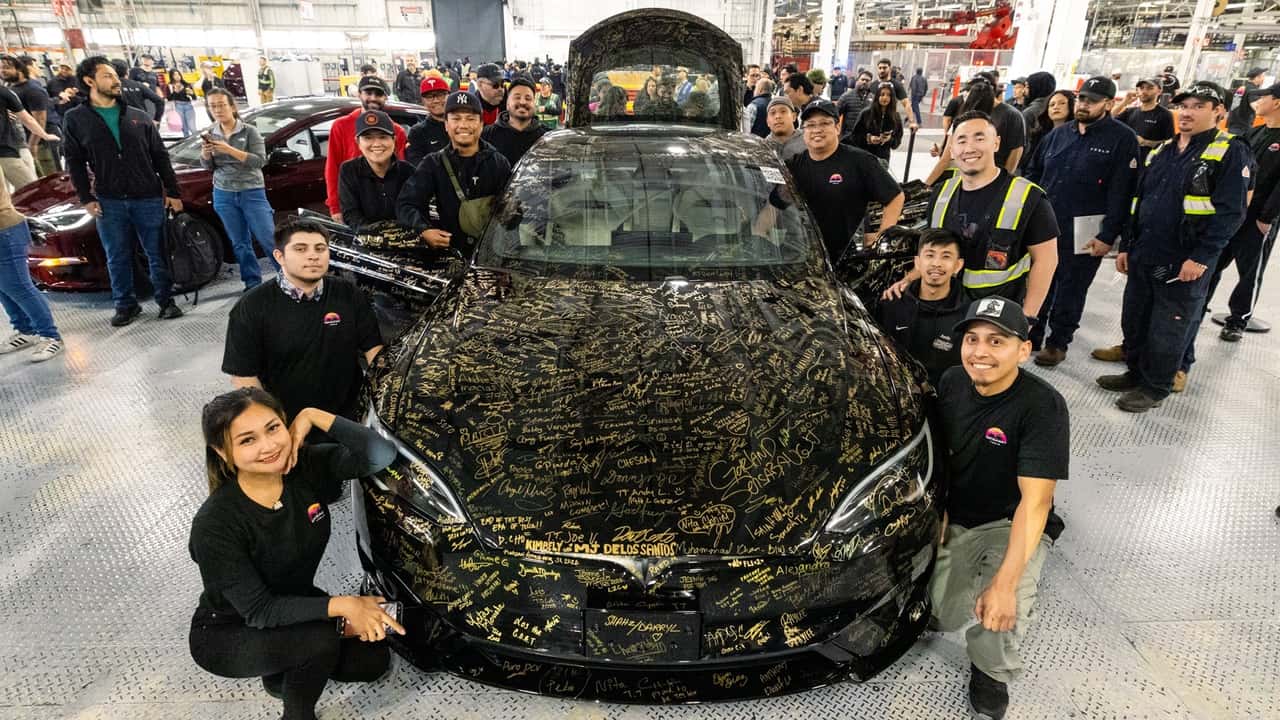
The final Model S and Model X have rolled off the line, marking a strategic pivot for Tesla beyond its luxury origins.
The final Tesla Model S and Model X vehicles have rolled off the assembly line, marking a definitive end to the production run of the two flagship models that originally launched the company into the mainstream automotive consciousness. This isn't merely a product discontinuation; it is a profound strategic recalibration for Tesla, signaling a pivot from its luxury, pioneering origins to a future firmly rooted in mass-market scalability, advanced manufacturing, and diversified energy solutions. The moment Tesla waves goodbye to Model S and Model X production is a clear declaration of its evolving priorities in a hyper-competitive global EV market.
A Legacy of Disruption: The Founding Pillars
When the Tesla Model S first launched in June 2012, it was nothing short of revolutionary. It arrived as a sleek, all-electric luxury sedan boasting unprecedented range, blistering performance, and a minimalist interior dominated by a large touchscreen. The Model S wasn't just an electric car; it was a technological statement that challenged the entrenched automotive establishment, proving that EVs could be desirable, high-performance, and practical. It quickly garnered accolades, including MotorTrend's Car of the Year, and fundamentally shifted perceptions of electric vehicles from niche curiosities to legitimate contenders against internal combustion engine (ICE) flagships from Mercedes-Benz, BMW, and Audi.
The Model X, introduced in September 2015, extended Tesla's ambition into the burgeoning SUV segment. With its distinctive Falcon Wing doors, panoramic windshield, and seating for up to seven, it aimed to blend utility with groundbreaking design. While its unique doors presented manufacturing complexities and initial reliability challenges, the Model X further cemented Tesla's reputation for audacious engineering and a willingness to challenge conventional automotive design principles. Together, the Model S and Model X established Tesla's premium brand identity, attracted early adopters, and funded the company's subsequent expansion into higher-volume segments.
The Strategic Imperative: Why Now?
The decision to discontinue these iconic models, while perhaps surprising to some outside observers, represents a logical and calculated move driven by several convergent factors:
Aging Platform and High Production Costs: The underlying architecture of the Model S dates back over a decade, and the Model X platform is not far behind. While both received significant refreshes over the years, including the "Plaid" performance variants, maintaining and updating these platforms became increasingly resource-intensive. Furthermore, the Model X, with its complex Falcon Wing doors and intricate interior components, has always been notoriously challenging and expensive to manufacture efficiently, impacting profit margins compared to newer, simpler designs.
Shift Towards Mass Market and Scalability: Tesla's stated mission is to accelerate the world's transition to sustainable energy. This mission is best served by producing millions of affordable EVs, not tens of thousands of premium luxury vehicles. The immense success of the Model 3 and Model Y, which now account for the vast majority of Tesla's sales volume globally, clearly demonstrated the market's appetite for more accessible EVs. Discontinuing the Model S and Model X frees up significant manufacturing capacity, engineering talent, and supply chain resources that can be redeployed towards the next-generation platform and higher-volume products.
Intensifying Competition in the Luxury Segment: When the Model S launched, it faced virtually no direct EV competition. Today, the premium EV landscape is crowded with formidable rivals. Mercedes-Benz offers the EQS, Porsche has the Taycan, Audi the e-tron GT, Lucid Motors the Air, and BMW the i7, among others. These competitors often bring decades of luxury craftsmanship, advanced features, and traditional dealership networks that cater to the discerning high-end buyer. Tesla's minimalist approach, while appealing to a specific demographic, no longer holds the singular technological advantage it once did in this segment.
Internal Cannibalization and Demand Shift: As the Model 3 and Model Y improved in range, performance, and feature sets, they began to offer compelling alternatives at significantly lower price points. A Model Y Performance, for instance, could offer acceleration rivalling early Model S variants for a fraction of the cost, potentially cannibalizing sales from its more expensive siblings. Moreover, global automotive demand has shifted decisively towards SUVs and crossovers, making the Model S sedan less aligned with market trends, and even the Model X SUV's unique design had its limitations in broad appeal compared to more conventional SUV offerings.
Production Volume Comparison (Approximate Annual Units)
Model S/X Combined: Typically under 100,000 units globally
Model 3/Y Combined: Exceeding 1.8 million units globally (2023)
This stark contrast highlights the strategic imperative to prioritize high-volume production.
Implications for Tesla's Future Portfolio and Brand
The discontinuation of the Model S and Model X is not a sign of weakness, but rather a maturation of Tesla's business strategy. It allows the company to:
Streamline Manufacturing: By focusing production lines on fewer, higher-volume models, Tesla can achieve even greater economies of scale, simplify its supply chain, and enhance manufacturing efficiency a core tenet of its future growth.
Reallocate Resources: Engineering and design teams previously dedicated to refreshing or maintaining the S/X platforms can now be fully concentrated on developing the "next-generation" vehicle platform, anticipated to underpin a significantly more affordable compact EV (often referred to as the Model 2), as well as advancing FSD (Full Self-Driving) capabilities, Optimus humanoid robots, and other AI initiatives.
Refine Brand Identity: While the Model S and X established Tesla as an innovator, the brand's future increasingly hinges on its ability to democratize electric transport and lead in AI and energy solutions. This move solidifies Tesla's identity as a technology company first and foremost, with automotive as a key, but not singular, component of its broader vision.
Financial Optimization: Lower production complexity and a focus on higher-margin, higher-volume vehicles can lead to improved overall profitability and capital efficiency, crucial for funding ambitious future projects like Robotaxi networks and large-scale energy storage deployments.
For existing Model S and Model X owners, the implications are likely minimal in the short to medium term. Tesla has a strong track record of supporting its vehicles with over-the-air software updates and maintaining a robust service network. Parts availability should remain strong, especially for common components shared across platforms. In the long term, these vehicles may even gain a unique status as foundational pieces of automotive history, potentially appreciating for enthusiasts, though broad market effects are difficult to predict.
Key Takeaways from the End of Model S/X Production
Strategic Shift: Tesla is fully pivoting from niche luxury to mass-market dominance.
Resource Reallocation: Engineering and manufacturing focus shifts to next-gen platforms and AI.
Enhanced Efficiency: Streamlined production and supply chain for improved margins.
Competitive Response: Acknowledging fierce competition in the premium segment.
Future-Proofing: Securing capital and talent for Robotaxi, AI, and energy ventures.
Looking Ahead: The Road Paved by S and X
The discontinuation of the Model S and Model X is not an end, but a necessary evolution. These vehicles were the trailblazers, proving the viability and desirability of electric vehicles at a time when skepticism was rampant. They built the brand, attracted the talent, and generated the capital that allowed Tesla to become the automotive giant it is today. Their legacy is etched into every Model 3, Model Y, and Cybertruck produced.
Tesla's future now hinges on its ability to execute its ambitious roadmap: bringing a truly affordable EV to market, scaling Cybertruck production, deploying FSD to a massive fleet, and integrating its energy storage and generation solutions globally. The "next-gen" vehicle, rumored to be built on a radically simplified manufacturing process, represents the logical continuation of the efficiency drive that led to this decision. Furthermore, the company's aspirations in robotics with Optimus, and its vision for autonomous ride-sharing with Robotaxis, signal a move far beyond traditional automotive manufacturing.
Conclusion
As the last Model S and Model X roll off the line, Tesla closes a significant chapter in its corporate history. This move, while symbolic, underscores a pragmatic and forward-looking strategy. It's a clear signal that Tesla is willing to make tough decisions to maintain its leadership position and achieve its long-term vision. The pioneering luxury EVs have served their purpose, laying the groundwork for a future where sustainable transportation and advanced AI are not just aspirations, but mass-market realities. The company is not retreating; it is refocusing its formidable capabilities on the next frontier.
Frequently asked questions
Why is Tesla discontinuing the Model S and Model X?
Tesla is ending production of the Model S and Model X as part of a strategic recalibration, shifting its focus beyond its luxury, pioneering origins towards a new future for the company. This move signals a pivot in its overall business strategy.
What will replace the Model S and X?
While no direct replacements have been announced, Tesla's strategic pivot suggests a focus on new models or technologies that align with its evolving business goals, potentially prioritizing higher volume or new market segments.
When did Tesla stop making Model S and X?
The final Tesla Model S and Model X vehicles recently rolled off the assembly line, marking the definitive end to their production run. The article indicates this is a current event, with the last cars having rolled off the line.
What was the significance of the Model S and Model X for Tesla?
The Model S and Model X were Tesla's flagship models, instrumental in launching the company into the mainstream automotive consciousness and establishing its reputation as a pioneer in luxury electric vehicles.
How does this discontinuation impact existing Model S and X owners?
The discontinuation primarily affects new car production. Existing owners can generally expect continued service, parts availability, and software updates, though long-term support specifics would depend on Tesla's policies.
What is Tesla's new strategic focus?
Tesla's strategic recalibration signals a pivot from its luxury, pioneering origins, suggesting a future focus on potentially different market segments, production strategies, or technological innovations beyond its initial flagship models.