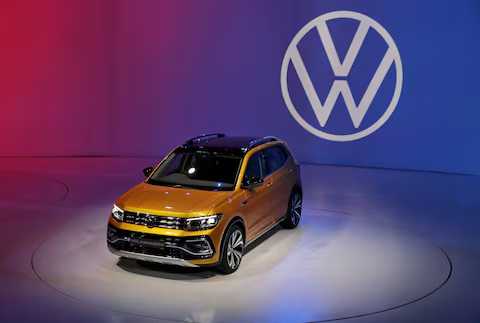
VWFS UK has appointed Wrisk Transfer Limited as its preferred insurance provider for Volkswagen Commercial Vehicles, under a partnership that gives VWCV customers up to three days of complimentary drive-away insurance immediately upon vehicle collection, followed by a no-obligation monthly quote for a fully comprehensive commercial van policy. Wrisk The mechanics are simple. The implications are not.
Why Volkswagen Moving Into Van Insurance Is Bigger Than It Sounds
The UK commercial motor insurance market grew 11.4% from 2022 to 2023 to reach £6.29 billion, with a further 7.4% growth expected in 2024. GlobalData Commercial vehicles are the market's fastest-growing application segment. Last-mile delivery demand has accelerated van registrations beyond 2019 levels, enlarging commercial risk pools. Mordor Intelligence Against that backdrop, sitting out of a £6-billion-plus market — particularly one where you already own the customer relationship at point of sale — starts to look less like restraint and more like negligence.
That logic is precisely what's driving VWFS's move. The partnership adds insurance into the ownership journey, with VWFS aiming to simplify onboarding and ongoing protection for commercial vehicle customers. Coverager But "simplify onboarding" undersells what's actually happening here. What VWFS is building is a closed-loop commercial relationship: finance, vehicle, insurance, approved repairs, genuine parts — all under the Volkswagen banner, all generating data, all creating retention touchpoints that a broker or aggregator simply cannot replicate.
The product details reinforce this. The van insurance offering, arranged and administered under the "Volkswagen Van Insurance Services" trading name of Wrisk Transfer Limited, covers repairs completed by Volkswagen-approved repairers performed by Volkswagen-trained technicians, with uninsured driver cover, UK accident recovery, and no tie-in, no up-front deposits, and no interest charges. Vwfs That last cluster of features is deliberately positioned against the friction points that make commercial operators dread renewing insurance.
Wrisk: The Quiet Architect of Automotive Embedded Insurance
To understand why VWFS picked Wrisk — and not one of the incumbent commercial insurers — you need to understand what Wrisk actually is. It isn't an insurer in the traditional sense. It's a digital infrastructure layer for automotive OEMs that handles everything from quote-and-bind to renewal and claims, while wearing the brand of the automaker it serves.
Founded in 2016, Wrisk provides a data-driven platform purpose-built for automotive brands to deliver embedded and branded insurance experiences across the full ownership lifecycle. The company powers insurance programmes for BMW, MINI, Volvo, Mercedes-Benz, Jaguar Land Rover, and Stellantis. EU-Startups Volkswagen Commercial Vehicles now joins that roster — and notably, it's the only van-specific commercial deployment in a portfolio otherwise dominated by passenger-car brands.
Wrisk recorded triple-digit revenue growth in 2024, with more than 100,000 policies written during the year. EU-Startups That's not a startup still searching for product-market fit. That's a company at the inflection point between growth-stage insurgent and category leader. Allianz Holdings — Wrisk's primary underwriter for nearly a decade — made a strategic equity investment into the company as part of its Series B round ReinsuranceNe.ws, an unusual move that blurs the line between underwriter and strategic investor and signals just how seriously the incumbents are taking the embedded model. Allianz has been Wrisk's primary underwriter for almost ten years. Coverager
The Series B itself told a story. Wrisk secured €13.9 million, co-led by Mundi Ventures and Opera Tech Ventures — the venture arm of BNP Paribas — both of whom joined the board. EU-Startups BNP Paribas's involvement through Opera Tech Ventures is not incidental. It connects the automotive insurance stack directly to the world of vehicle financing and banking infrastructure, a convergence that makes the VWFS partnership look less like a one-off deal and more like a template.
"By offering motor insurance, we are extending our relationship with customers beyond finance, helping to make it easier to get on the road and stay protected. This partnership reflects our focus on delivering simple, practical solutions that support customers throughout their ownership journey."
— James Taylor, Head of Product (non-asset based), Volkswagen Financial Services UK
The Embedded Insurance Surge — and What's Driving It
A Q1 2025 industry poll found that 31.6% of respondents believe embedded insurance will experience the most significant growth within personal lines insurance over the next five years — outpacing both direct-to-consumer models (18.4%) and traditional broker networks (17.2%). Aon Those are striking numbers for what was, five years ago, a relatively niche channel.
The structural reason is straightforward: insurance sold at the point of asset delivery has fundamentally different economics than insurance sold on price-comparison aggregators. Attach rates are higher. Customer acquisition costs are lower. Brand alignment is stronger. And the data generated from OEM, finance, and insurance systems working together creates pricing and risk advantages that commodity brokers cannot match.
The global embedded insurance market was valued at $143.88 billion in 2025 and is projected to grow to $1.46 trillion by 2034 at a 30.3% CAGR. Fortune Business Insights The automotive segment is the single largest application category, commanding roughly 30% of market share. Every major OEM that isn't building an embedded insurance capability right now is, in effect, donating revenue and customer data to someone else.
For VWFS specifically, the commercial vehicle segment is particularly attractive. Small-to-medium enterprises operating Volkswagen vans — Crafters, Transporters, Caddys — tend to be stickier customers than private car buyers. They buy in cycles, they service regularly, they have genuine operational dependency on their vehicles. Insurance that's baked into the dealership collection moment and renewed monthly with no tie-in is built for exactly this customer.
From a regulatory standpoint, the UK's Financial Conduct Authority has tightened its Consumer Duty framework — which came into full force in 2023 and extended to closed products in 2024 — requiring firms to demonstrate genuine value for insurance products sold. That has accelerated the shift away from opaque bundled policies toward transparent, flexible offerings. Wrisk's monthly rolling subscription model, with no up-front deposits, is precisely the architecture the FCA's Consumer Duty rewards. VWFS is not just entering an insurance market; it's entering it with a product design that regulators actively prefer.
What the Policy Actually Covers — And What It Replaced
The timing of the launch carries a telling detail. For policies quoted on or before 30 March 2026, VWFS UK's van insurance was previously underwritten by Churchill Van Insurance. The Wrisk transition took effect for policies quoted on or after 31 March 2026. Vwfs Churchill — owned by Direct Line Group — is a household name. Replacing it with a white-label Wrisk product operating under the "Volkswagen Van Insurance Services" brand represents a deliberate decision to prioritise brand ownership over borrowed credibility.
The coverage includes access to Volkswagen-approved repair centres, use of genuine parts, and protection for tools damaged or stolen from the vehicle. Wrisk That last element — tool theft cover — is not a throwaway add-on. Tool theft from commercial vans costs the UK trades sector an estimated £500 million annually, according to industry figures, and it's the single most cited pain point among tradespeople and sole operators. Including it as standard is a product decision that demonstrates genuine familiarity with the commercial van customer's actual experience, not just their insurance risk profile.
The monthly, no-obligation quote structure is equally intentional. Annual policies with locked-in premiums work against operators whose business needs change — a sole trader who adds a second van mid-year, a delivery operator scaling down in a slow quarter. Monthly rolling cover with a guaranteed price for 12 months threads that needle.
Key Takeaways
1. This is a loyalty play, not just an insurance play. VWFS is extending its customer relationship from the finance moment into ongoing ownership — keeping Volkswagen's brand touchpoint active between services and renewals.
2. Wrisk is becoming the default embedded insurance infrastructure for European automotive OEMs. With BMW, MINI, Volvo, Mercedes-Benz, JLR, Stellantis, and now Volkswagen Commercial Vehicles, the company has assembled a portfolio that would be extremely difficult for any new entrant to replicate.
3. The commercial van segment is underserved by digital insurance models. Most insurtech disruption has targeted personal lines. VWFS and Wrisk moving into van insurance at the point-of-collection moment targets a gap that price-comparison sites have never adequately addressed for SME operators.
4. Allianz's dual role — as underwriter and equity investor in Wrisk — creates competitive complexity. Allianz also holds a five-year passenger car insurance partnership with VWFS UK for VW Group brands. Wrisk now connects both sides of the Volkswagen financial services ecosystem.
5. The FCA's Consumer Duty framework favours exactly this product structure. Monthly rolling policies, transparent pricing, and genuine-parts guarantees are the architecture that regulators and customers both prefer in 2026.
The Honest Counterargument
Not everyone will buy the embedded insurance pitch uncritically, and rightly so. Captive distribution models have a history of producing mediocre products at premium prices precisely because they eliminate the competitive pressure that aggregators apply. A tradesperson who would have found cheaper, better-suited cover via a broker or comparison site might find themselves defaulting to the Volkswagen-branded policy because it's right there, at the moment of lowest cognitive resistance.
Wrisk's proprietary embedded data framework harmonises inputs across connected car systems, telematics, transactional records, and customer interactions EU-Startups — which is powerful, but it also means the insurer knows more about the risk than the customer does at point of purchase. Whether that asymmetry benefits pricing fairness or insurer margins is a question regulators will eventually ask more loudly.
Robert Cottrell, VP Commercial at Wrisk, framed the partnership around "truly customer-centric products" and a "shared vision of bringing the highest standards of digitally delivered insurance to customers." Wrisk That's the right framing. Whether it holds up when renewal rates, claims handling times, and actual premium competitiveness are measured publicly — against the broader commercial van market — will be the real test.
The Global Playbook Taking Shape
Zoom out, and the VWFS-Wrisk van insurance deal is one tile in a much larger mosaic. Wrisk is expanding across Europe with a commercial team in Munich and regulatory licences secured, positioning itself to support new clients while enabling existing UK partners to scale into European markets. Insurance Edge Volkswagen Group operates across dozens of European markets. The commercial van partnership in the UK is, in all probability, a proof-of-concept for a broader European rollout.
For the global insurtech ecosystem, the lesson is structural. Embedded insurance in automotive is no longer experimental. It's becoming the default. The question for every insurer, OEM, and financial services provider watching this deal isn't whether to build embedded capability — it's how fast they can do it before Wrisk and its OEM partners make the territory unavailable.
Volkswagen didn't just sign an insurance deal. It signed a statement of intent about who controls the commercial van customer relationship. And for the foreseeable future, that answer is increasingly: Volkswagen.