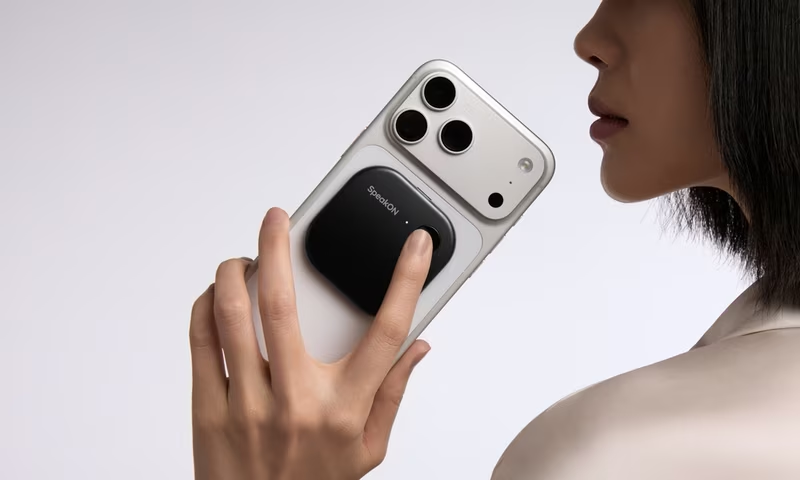
People speak at roughly 130 words per minute. They type at around 40. That gap has existed for decades, and yet dedicated dictation hardware has remained a niche product for doctors and lawyers who can afford Dragon's $150-a-year licensing fees. SpeakOn, built by Tokyo-based Notta — which has raised $31.5 million from investors including Granite Asia, GSR Ventures, and CDH Investments — wants to change that with a 25-gram pebble that sticks to the back of your iPhone via MagSafe and promises to close that 90-word-per-minute gap for everyone.
The device is priced at $129, includes a plan for 5,000 words of dictation per week, and pairs with a $12-per-month subscription for unlimited words. That's not a casual price point. SpeakOn is pitching this at the same crowd that pays for Wispr Flow — which raised $81 million in total funding and is now valued at $700 million — and competing against a category that's attracting serious capital, serious engineers, and serious software-first approaches.
After hands-on testing, the honest answer is: SpeakOn has identified a real problem. Its solution is genuinely interesting. And it's being held back by constraints that have nothing to do with Notta's engineering ability.
The Case For Dedicated Dictation Hardware — and Where SpeakOn Fits In
The software-only dictation market is saturated and, for most users, perfectly adequate. Wispr Flow works across Mac, Windows, iOS, and Android. YC-backed Willow offers local on-device processing for privacy-conscious users. Monologue, Typeless, Aqua — there are genuinely good options at every price point and privacy preference. So what's the actual argument for a dedicated hardware device?
SpeakOn's clearest advantage is that it doesn't use the iPhone's microphone. Other dictation apps need to keep the iPhone mic active based on session time the user has set. SpeakOn's dedicated microphone bypasses that constraint entirely. For anyone who's tried to run a long dictation session while also taking a call, checking notifications, or doing literally anything else that touches the microphone, that matters. It's not a gimmick. It's a real architectural difference.
The form factor makes intuitive sense. A MagSafe attachment means zero setup friction — you pop it on the back of your phone, press the button to record, release when you're done. The device supports 10 hours of continuous use and claims 20 days of standby. In practice, standby was closer to a few days — the device never turns off by default, which is a firmware problem, not a concept problem. Battery discipline aside, the physical experience of pressing a dedicated button to speak feels meaningfully different from hunting for a microphone icon in a software keyboard. That tactile simplicity is the product's best quality.
The Platform Wall That SpeakOn Can't Climb
Here's where the review gets uncomfortable.
The dictation works in any app — but only as long as the software keyboard is active. That means users have to switch to the SpeakOn keyboard manually before they can dictate. Double-tapping the record button can't bring the SpeakOn keyboard forward if another keyboard is active. The reviewer couldn't start speaking without switching keyboards — and those are system-level limitations that are possibly hard to overcome.
That qualifier — "system-level limitations" — is doing a lot of work in that sentence. What it means, practically: Apple controls what third-party keyboard extensions can and can't do on iOS. SpeakOn didn't design those constraints. Notta can't remove them. No firmware update changes them. The only entity that could meaningfully fix this experience is Apple, and Apple has its own dictation product built into every iPhone it ships.
This isn't a small problem. It's the central tension of the entire hardware-plus-software-keyboard architecture. SpeakOn is building a physical input device on top of a platform that doesn't treat third-party keyboards as first-class citizens. Every friction point a user encounters — the keyboard-switching requirement, the inability to directly summon the interface — flows from that constraint.
"At a glance, it will likely be difficult to spot the change in depth, and the iPhone Air line gives the Pro line more room to trade sleekness for performance."
Actually, that's the wrong quote. Here's the honest one from testing: when "Does this app work automatically?" comes out as "Does this application operate automatically?", and "Sure, no worries" becomes "There is no need to be concerned" — the AI editing layer isn't helping. It's rewriting. That's a software judgment call Notta made, and one they can change. The hardware-imposed limitations, they cannot.
The Skeptic's Corner: Does Dedicated Dictation Hardware Make Any Sense?
One non-obvious observation: SpeakOn might be solving the wrong problem at the wrong layer.
Wispr Flow, which now works across Mac, Windows, iOS, and Android, uses the platform's own microphone infrastructure and still achieves 95%+ accuracy in quiet environments — around 92% on iPhone with earbuds. That's not dramatically worse than what a dedicated mic achieves under ideal conditions. The variable isn't really mic quality — it's noise environment. And a dedicated mic that clips to your phone doesn't help much if you're on a busy train, in a coffee shop, or anywhere with significant ambient sound. SpeakOn's review noted the device underperforms because of surrounding noise even within two feet of range.
What SpeakOn actually needs to be valuable isn't a better mic — it's what Shure, Røde, and professional audio manufacturers have known for years: directional microphones that reject ambient noise through beam-forming and cardioid pickup patterns. A 25-gram pebble can't house that hardware meaningfully. The physics don't cooperate.
The Global Dimension: Voice Input Is Not a Universal Experience
The dictation category is genuinely global but its biggest headaches are distributed unevenly.
Wispr Flow's CEO Tanay Kothari noted that 40% of dictations on the app are in English, with the remaining 60% split across Spanish, French, German, Dutch, Hindi, and Mandarin as top languages. SpeakOn's translation feature covers 12 languages — English, Japanese, Korean, Simplified and Traditional Chinese, Spanish, French, German, Italian, Portuguese, Russian, and Arabic. That's notably well-positioned for the Asian markets where parent company Notta has its deepest roots.
Notta is headquartered in Tokyo, with backing from Mizuho Financial Group and CDH Investments alongside Granite Asia and GSR Ventures. Its multilingual orientation isn't accidental — the Japanese enterprise market has historically been more receptive to dedicated hardware input devices than the US consumer market, and the code-switching demands of multilingual Asian professionals (mixing English with Mandarin, Japanese, or Korean in the same document) genuinely benefit from the kind of real-time AI editing SpeakOn provides. The "Attune" tone-changing feature that frustrated the English-language reviewer may be considerably more valuable to someone polishing professional Japanese correspondence while thinking in English.
That's a narrower but realer market than the "replace your keyboard" ambition the product seems to have in English-language marketing.
What the SpeakOn review actually reveals, distilled into three things worth knowing:
The hardware concept is sound; the market timing depends entirely on platform access. SpeakOn's dedicated microphone architecture solves a real problem — freeing the iPhone mic while enabling always-ready dictation. That advantage collapses if Apple ever ships deep third-party microphone API access or builds competitive dictation hardware itself. The risk isn't product quality. It's platform dependency.
The AI editing layer needs a hard mode. Turning "Sure, no worries" into "There is no need to be concerned" isn't transcription assistance — it's ghostwriting nobody asked for. The reviewer had to disable Attune entirely to get usable output. A product that requires users to turn off its marquee AI feature to work well has a calibration problem, not a hardware problem.
At $129, SpeakOn is competing against $0. Apple Dictation ships on every iPhone. Wispr Flow's free tier allows 2,000 words per week. SpeakOn's hardware cost plus subscription represents a meaningful commitment for a product whose biggest friction points stem from platform limitations Notta can't resolve.
What to Watch
Plaud's next move.Plaud's AI meeting notetaker uses the same MagSafe form factor and is reportedly working on a dictation-focused variant. If Plaud ships a competing device with better mic hardware and a stronger enterprise pitch, SpeakOn's early-mover advantage evaporates quickly.
Whether Apple opens its microphone APIs. iOS 18's privacy framework tightened third-party audio access further, not less. If that trend continues with iOS 19, the keyboard-switching friction in products like SpeakOn becomes permanent, not temporary.
Notta's hardware roadmap. TechCrunch's reviewer noted SpeakOn "has an early mover advantage in releasing a dictation device" but that "another company could easily source components and put them in a different form factor to eat up market share." Notta needs version two to ship with substantially better microphone hardware and Mac compatibility before a well-funded competitor takes that observation seriously.
There's a version of SpeakOn that's genuinely excellent: better mics, Mac support, a toned-down AI editing layer, and the kind of platform access that lets a dedicated button summon the keyboard without a manual switch. That version doesn't exist yet. What does exist is an honest first attempt at a product category that deserves to exist — made by a company that understands the dictation problem better than most of its competitors and is being constrained, fairly brutally, by a platform it can't negotiate with.
If you're a power dictation user who's frustrated with mic conflicts on iOS, SpeakOn is worth the $129 curiosity tax. If you're a developer evaluating whether to build on Notta's API or integrate with Wispr Flow's developer-facing infrastructure, SpeakOn's hardware ambitions are the more interesting long-term bet — assuming platform access doesn't stay this limited.
For now, though, the most honest thing you can do after reading this is download Wispr Flow's free tier and test whether you even need the hardware at all. You might not. And if you don't, that tells you more about the dictation market in 2026 than any product review can.