Washington's export controls were supposed to freeze China out of the AI race. Instead, they handed Huawei a captive market of a billion-dollar scale — and DeepSeek just pulled the trigger.
The proximate facts are straightforward: within days of DeepSeek releasing its V4 model last week, ByteDance, Tencent, and Alibaba all reopened procurement discussions with Huawei for its Ascend 950PR AI chips. Cloud providers and GPU rental operators are also scrambling for allocation. But the deeper story is not a procurement surge. It's the moment a strategic bet — years in the making, funded by geopolitical adversity — finally found its validation event.
What Actually Happened
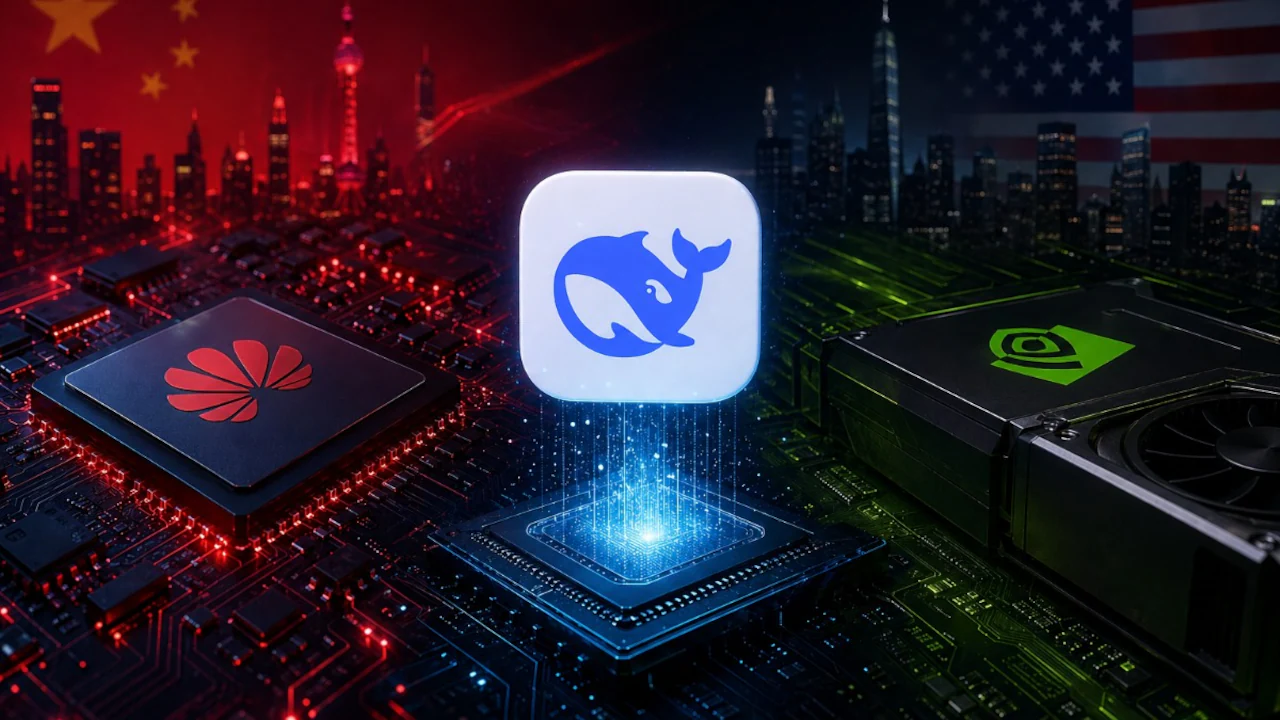
DeepSeek didn't merely launch a new model. It launched a new model explicitly optimized for Huawei hardware, and then announced that the Ascend SuperNode infrastructure would fully support V4 inference across its entire product line. That last detail is the one most analysts missed. It means DeepSeek and Huawei coordinated the release — hardware-software co-design at a level that CUDA-dependent Western AI labs routinely do with Nvidia, but that China's domestic ecosystem has never credibly demonstrated before.
ByteDance has reportedly committed approximately $5.6 billion in orders for the Ascend 950PR — the largest single AI chip procurement commitment from a Chinese company to a domestic chipmaker. Alibaba and Tencent have also placed significant orders. Alibaba Cloud's Bailian platform offered DeepSeek V4 the same day it launched, listing both the V4-Pro and V4-Flash variants at DeepSeek's official prices. Tencent Cloud rolled out V4 preview services on its TokenHub platform that same day, running it on domestic infrastructure plus a Singapore gateway for international users.
The velocity matters. Same-day availability at this scale — across multiple major clouds simultaneously — signals pre-planned infrastructure readiness, not reactive deployment. These companies had the chips, had tested the model, and were waiting for the launch window.
The Performance Equation Has Shifted
The Ascend 950PR outperforms Nvidia's H20 by approximately 2.8x on FP4 workloads — and Nvidia's H20 is no longer even legally available in China following Beijing's import block last year. The 950PR trails Nvidia's H200, but the H200 exists in a regulatory no-man's-land that makes it practically inaccessible to Chinese buyers regardless of price.
This is the paradox Washington created. By incrementally ratcheting up export controls — restricting the A100, then the H100, then downgrading to the H800 and H20 for China — US policy gave Huawei a clear performance target to engineer toward, a guaranteed demand pool with no alternative, and years of runway to build the software ecosystem to match. The 950PR is currently positioned between Nvidia's H100 and H200 in capability, with production capacity remaining the main bottleneck. The 950B handles training workloads, while the 950PR is optimized for inference — meaning Chinese AI labs running both have a fully domestic hardware stack with no Nvidia dependency at any point in the development cycle.
The CUDA question — long considered Nvidia's most durable moat — is now explicitly contested. The 950PR carries a CUDA-compatible software stack, which is described as the feature that fundamentally changes the China AI chip landscape. If production engineering teams can migrate existing CUDA codebases to run on Ascend with minimal friction, the retraining cost argument for staying with Nvidia evaporates.
"If DeepSeek succeeds in running both inference and training on Ascend chips within the next one to two years — and stabilizes the full software stack including compilers, operators, communication libraries, distributed training, and inference frameworks — then its core model development pipeline could effectively become independent of CUDA."
— Weijin Research, cited by EE Times China
The Supply Bottleneck: Demand Proof Is Not Delivery Proof
Huawei aims to ship roughly 750,000 units of the 950PR this year, with mass production starting in April and full-scale shipments targeted for the second half of 2026. That is a credible number given the order pipeline — but it also exposes the central vulnerability of China's domestic AI compute story.
DeepSeek acknowledged that supply constraints will persist until production ramps up, reflecting the tight supply of high-end homemade AI chips. The constraint is not engineering ambition; it's lithography. US export controls on advanced semiconductor manufacturing equipment — enforced through ASML's EUV restrictions and the Commerce Department's Entity List — mean that SMIC, the primary fabrication partner for Huawei's Ascend line, is operating without access to the world's most advanced process nodes. The upcoming 960 and 970 chips are in the pipeline, each targeting roughly 2x performance gains, but each generation will face the same equipment ceiling until China either develops indigenous EUV tools — a multi-year project — or finds alternative fabrication pathways.
For enterprise decision-makers globally watching this dynamic, the supply gap is a strategic signal: Chinese cloud infrastructure is about to tighten further before it loosens. Any organization with significant China-based AI workloads should be modeling second-half 2026 compute availability scenarios now.
Who Wins, Who Loses — And Who Gets Complicated
Huawei is the unambiguous winner of this week's events. The company has spent years building an AI chip program that most Western analysts dismissed as aspirational. The scramble from ByteDance, Tencent, and Alibaba — companies that have historically preferred Nvidia hardware — is the market validation Huawei needed to anchor its position as the default domestic AI infrastructure provider.
DeepSeek wins by becoming the de facto standard model layer for Chinese enterprise AI, with a guaranteed distribution channel through every major cloud. Its MIT-licensed open-source approach also accelerates ecosystem adoption in a way that proprietary model providers cannot match — V4's MIT license means any developer can fine-tune, deploy, and redistribute it, compounding inference demand on Ascend hardware.
Nvidia faces an accelerating loss of a market that was already slipping. The H20 ban removed its last significant China revenue stream, and the Ascend 950PR's CUDA compatibility means it can now pursue Nvidia's installed base rather than just greenfield deployments.
Global enterprise buyers face a more nuanced calculus. If your AI infrastructure or vendor relationships have exposure to Chinese cloud capacity — Alibaba Cloud's international business, Tencent Cloud's Singapore nodes — you need to understand that the underlying compute stack is now explicitly decoupling from Western semiconductor supply chains. Compliance teams at multinationals with operations in China will need updated assessments: running workloads on Ascend-based infrastructure has different supply chain, data sovereignty, and geopolitical risk profiles than running on equivalent Nvidia-based infrastructure.
India's semiconductor ambitions, backed by the India Semiconductor Mission and recent fab investments by Tata Electronics and CG Power, now have a clearer competitive reference point. China's model — state-backed demand aggregation, mandatory domestic procurement, and coordinated model-chip co-development — is the playbook that regional tech ministries from New Delhi to Riyadh are studying.
Skeptic's Corner
The narrative of a fully independent Chinese AI stack deserves scrutiny. First, CUDA compatibility claims require independent verification — the gap between "runs CUDA code" and "runs CUDA code at production performance parity" is wide, and no neutral benchmarks exist yet. Second, 750,000 units sounds large until you consider that a single hyperscale AI training cluster can consume tens of thousands of chips. Third, DeepSeek's 75% developer discount until May 5 is a demand-generation tactic, not organic adoption — the real test is whether enterprise inference pricing at scale remains competitive once subsidies end.
What's genuinely unknown: whether the Ascend 950's performance on mixed training-inference workloads holds up at the cluster sizes that ByteDance's recommendation systems or Alibaba's Tongyi models actually require.
Key Takeaways
DeepSeek V4's native Huawei optimization transformed a hardware bet into a hardware standard practically overnight
ByteDance's reported $5.6B commitment is the largest domestic chip order in Chinese tech history
The CUDA-compatibility claim on the 950PR, if verified, changes the software migration calculus for every enterprise running Nvidia in China
Supply will remain constrained through mid-2026, with full-scale 950PR shipments only expected in H2
The Ascend 950B (training) + 950PR (inference) combination represents a complete domestic AI compute stack — a first for China
What to Watch
Whether SMIC can hit the 750,000-unit production target given its DUV-only lithography constraints — any slip here ripples across every major Chinese cloud's H2 AI rollout
Third-party benchmark verification of the 950PR's CUDA-compatible stack at enterprise scale, which is the single most consequential data point for global AI infrastructure planning
The Commerce Department's response — the Ascend 950PR's performance gains may trigger a fresh round of equipment export restrictions targeting SMIC's existing toolchain
Pricing normalization signals from DeepSeek post-May 5, which will reveal actual demand elasticity once subsidy effects are stripped out
How Tencent Cloud's Singapore gateway — running DeepSeek V4 on Huawei-based infrastructure — is treated by Southeast Asian regulators navigating US-China tech decoupling pressures
The central question this story raises is not whether China can build competitive AI chips. This week's events suggest it already has. The question is whether it can build enough of them — and whether the software ecosystem will hold at the cluster sizes that actually define frontier AI capability. Those answers won't come from procurement announcements. They'll come from benchmark logs, shipment manifests, and the quiet decisions of enterprise infrastructure teams over the next six months.