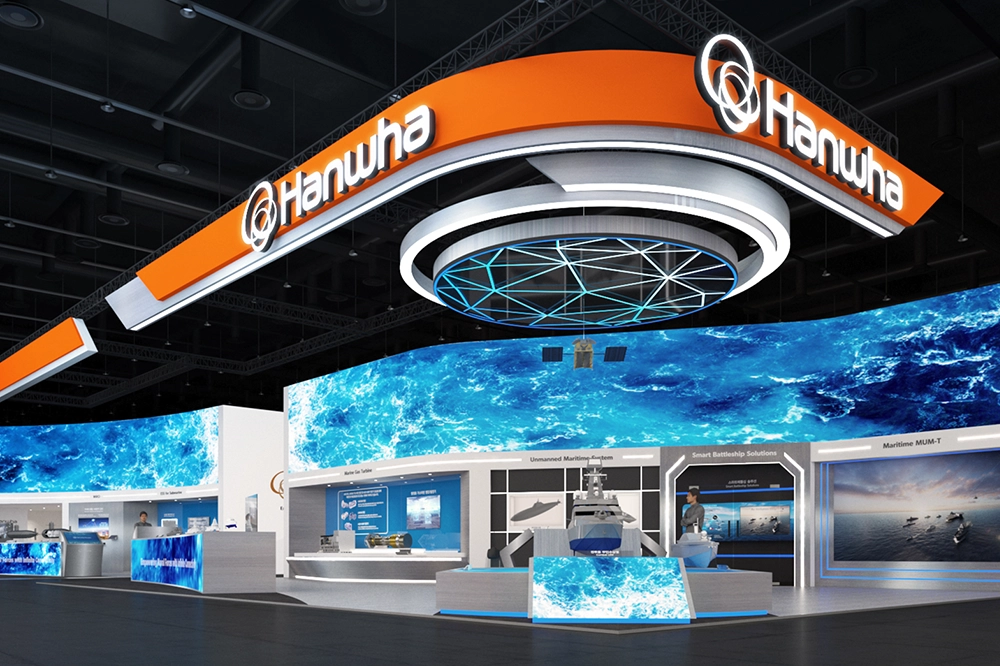
The conglomerate that makes howitzers and satellites and autonomous warships is now fusing all three with artificial intelligence. South Korea's strategic bet on space-based AI isn't just a defense play — it's a template for the next generation of tech-industrial power.
Fifteen centimeters. That's the size of the smallest object Hanwha Systems aims to identify from orbit. Not from a drone hovering a thousand feet overhead. From space — through clouds, at night, in any weather. The company is currently developing a next-generation small synthetic aperture radar satellite with ultrahigh resolution capable of identifying objects as small as 15 centimeters from space, slated for launch within 2026.
That single specification summarizes a transformation that has been years in the making: South Korea's Hanwha Group — a sprawling conglomerate whose product range stretches from artillery shells to solar panels — is executing one of the most ambitious AI and space integration strategies in the global defense industry. And it's doing so faster, cheaper, and with more vertical integration than any Western competitor has managed in the same timeframe.
This is not a story about a defense contractor adding an AI press release to its investor deck. It's a story about a South Korean industrial giant rearchitecting itself around the thesis that the next geopolitical battleground is overhead — and that AI-powered satellite intelligence will be its primary currency.
How Hanwha Is Turning South Korea Into an AI-Space Power
At the center of the effort is Hanwha Systems, which has been strengthening its synthetic aperture radar (SAR) satellite technology following the successful launch of Korea's first domestically developed small SAR satellite in December 2023. Unlike optical cameras that require clear skies and daylight, SAR systems use microwave radar that can penetrate clouds and operate regardless of weather or time of day, enabling high-precision Earth observation and reconnaissance.
Hardware alone isn't the point. Beyond manufacturing, Hanwha is expanding into satellite data services by integrating AI into its space platform. High-resolution imagery captured by its satellites is analyzed in near real time through the company's AI systems, allowing rapid detection of anomalies and transmission of intelligence to command systems. The company has also developed a mobile ground station with AI-based image analysis — designed to maintain operability in wartime environments where fixed communication infrastructure may be compromised.
That last detail matters more than it initially seems. Hanwha isn't building surveillance capabilities for peacetime monitoring. It's engineering resilience into the system architecture specifically for conflict scenarios. That's not a civilian satellite company's design philosophy. It's a defense prime's.
The geopolitical driver is explicit. Korea is preparing to advance a multi-ministry-led project to deploy a constellation of around 40 SAR satellites aimed at strengthening surveillance capabilities over the Korean Peninsula and surrounding regions. Hanwha Systems, teaming with its subsidiary Satrec Initiative, is proposing an integrated "panel-type" design where the payload, bus, and solar arrays are fused into a compact structure to maximize packing density inside the launch fairing — leveraging heritage from its 1-meter resolution SAR satellite launched in 2023 and resolution reportedly reaching 25 centimeters.
Its competitor for that contract is Korea Aerospace Industries (KAI). The winner will command not just the initial 40-unit order — winning will lead to a higher likelihood of repeated future production orders, and potentially entry into the broader K-LEO project, expected to operate more than 200 satellites. Mass production at scale. That's the endgame.
The Jeju Space Center Is the Physical Proof of Strategy
When a company builds a factory, it's making a bet. The question is what kind.
With the completion of the Jeju Hanwha Space Center in December 2025 — Korea's largest satellite mass-production facility — the scope of AI applications in the space industry is expected to expand significantly and drive the next phase of innovation within Hanwha's space technology ecosystem. Initial production capacity sits at approximately two satellites per month, with potential to increase to eight per month depending on the success of order intake.
Eight satellites a month would be 96 per year. That's a production rate that rivals the most aggressive commercial constellation operators in the United States. For a country that was dependent on foreign satellite technology a decade ago, it represents a structural leap — the kind that doesn't reverse.
Hanwha's vertical integration strategy amplifies this. With Hanwha Aerospace producing the Nuri launch vehicle and Hanwha Systems building the payloads, the conglomerate aims to control the entire value chain. Build the satellite. Launch the satellite. Analyze the data. Sell the intelligence. Few companies anywhere in the world can say that. SpaceX approaches it on the commercial launch side. Lockheed Martin and Northrop Grumman approximate it on the defense side. Hanwha is threading both needles simultaneously.
"The defense industry is expanding its focus beyond land, air, and sea to space. Space is the next battlefield in the power struggle, and the weapon on that battlefield will be satellites."
— Bae Sungjo, Research Analyst, Hanwha Investment & Securities
Bae's framing isn't incidental. Hanwha Investment & Securities — the financial arm of the same conglomerate — is publishing bullish research on the same satellite companies that Hanwha Group is competing against. The self-referential nature of that ecosystem is either a conflict of interest or proof of ecosystem coherence, depending on your perspective. Either way, it signals just how comprehensively Hanwha has organized itself around this thesis.
The Global Expansion Play: From Seoul to Riyadh to Maryland
The space and AI ambitions don't exist in isolation. Hanwha is running simultaneous market offensives across three continents — and the AI thread runs through all of them.
At the World Defense Show 2026 in Riyadh, Hanwha displayed a next-generation AI satellite imagery analysis solution that integrates and analyzes information collected from various surveillance assets such as satellites and drones using AI to support rapid decision-making — capable of identifying targets such as aircraft and vehicles and estimating the scale of damage when disasters occur. The pitch to Saudi Arabia is explicit: the system, linked with weapon platforms, is expected to extend to support precision strikes and battlefield damage analysis. Defense export, AI product, and geopolitical relationship-building, in one demonstration.
At FIDAE 2026 in Santiago — Latin America's largest defense exhibition — Hanwha Systems exhibited a compact SAR satellite capable of 25 cm resolution observation regardless of time of day or weather, combined with its proprietary AI satellite image analysis solution to enhance speed and accuracy of tactical decision-making.
Then there's the United States — the most strategically significant front. At Sea-Air-Space 2026, Hanwha Aerospace signed a Memorandum of Agreement with Northrop Grumman to cooperate on developing the first-stage solid-fuel propulsion system for the Advanced Reactive Strike missile system. Hanwha isn't just selling to the US military. It's embedding itself into the US defense industrial base — partnering with the same Northrop Grumman that builds intercontinental ballistic missiles and B-21 bombers. That's not a vendor relationship. That's strategic interdependence.
Hanwha Defense USA and Magnet Defense signed an agreement to jointly build a 38-meter unmanned surface vessel for the Pentagon, develop AI-driven robotic shipyards, and collaborate on advanced AI software for improving autonomy. AI-driven robotic shipyards. Read that phrase carefully. Hanwha isn't just proposing to build autonomous ships — it's proposing to build the automated factories that build autonomous ships.
The South Korea AI Policy Engine Behind Hanwha's Push
Hanwha's moves don't happen in a policy vacuum. South Korea's Lee administration's 2026 budget proposal includes plans to expand R&D spending 19% year over year, and the government plans to establish a National Growth Fund valued at KRW 100 trillion ($72 billion) via private-public joint financing — intended to absorb losses before private investment to encourage private capital into risky advanced industries.
In August 2025, South Korea launched a five-year plan to build a "super-innovation economy," investing $71.5 billion in AI across all sectors — developing a sovereign Korean-language AI model, humanoid robots, autonomous vehicles, and AI integration in healthcare, education, and defense. Hanwha isn't just the beneficiary of this policy environment. It's one of the primary industrial execution vehicles for it.
The global satellite market is projected to reach $615.7 billion by 2032, growing at 8.1% annually. Total private investment in space technology grew 48% in 2025 to $12.4 billion — surpassing the previous record set in 2021 — with investor expectations for 2026 focused on sovereign satellite programs, missile defense systems, and AI integration into space hardware and data analytics. Hanwha's strategic positioning couldn't be better timed.
One honest counterweight: South Korea's defense industry is facing mounting challenges in global markets despite record exports, as failed bids highlight limits beyond technological capability — with political, diplomatic, and financial factors increasingly determining outcomes in major international defense contracts. Winning on technology and losing on geopolitics is a real risk. Hanwha's partnerships with Northrop Grumman and Leidos Gibbs & Cox are partly designed to inoculate against exactly that problem — embedding Korean capability inside American industrial structures that carry their own diplomatic weight.
Key Takeaways
Hanwha's AI-space push in 2026 is not a single product launch. It's a systematic vertical integration strategy that, if it succeeds, positions South Korea as a full-spectrum space intelligence power by the end of the decade.
Hanwha Systems is developing a 15 cm resolution SAR satellite slated for launch in 2026, the most precise commercially-oriented Earth observation capability in the Korean defense industry's history.
The Jeju Space Center, completed in December 2025, can scale from two to eight satellites per month — moving Korea from artisanal satellite production to industrial-scale manufacturing.
The 40-satellite SAR constellation contract — evaluated by DAPA and KASA in October 2026 — is a winner-takes-all competition between Hanwha Systems and KAI that will define Korea's military satellite industrial base for a generation.
Hanwha's AI integration runs from satellite imagery analysis through autonomous naval vessels to AI-driven shipyard manufacturing — covering the full stack from space to sea.
Partnerships with Northrop Grumman and Leidos Gibbs & Cox in the US defense market signal a deliberate strategy to become structurally embedded in Western defense procurement rather than remaining an external export supplier.
The framing of South Korea as an AI and defense technology powerhouse has shifted, in a remarkably short period, from aspiration to observable fact. Hanwha Group is the clearest single embodiment of that shift. Its ability to build a satellite, launch it on a domestically produced rocket, analyze the imagery with proprietary AI, sell that intelligence to allied defense forces, and manufacture autonomous warships in partnership with America's largest defense contractors — all under one corporate umbrella — is a capability profile with no direct equivalent in Asia or Europe.
The question worth watching isn't whether Hanwha can build the technology. It already has. The question is whether South Korea can convert technological capability into geopolitical leverage at the pace the current threat environment demands. Kim Dong-hyun, head of Hanwha Aerospace's Land Systems Business Group, put it directly: "All weapons systems are becoming unmanned. By 2030, we plan to unveil a fully autonomous self-propelled howitzer."
In South Korea's AI-space industrial complex, Hanwha isn't waiting for the future. It's building the factory that manufactures it.
For more on South Korea's defense AI ecosystem and the global satellite market, follow StartupNews.fyi's ongoing coverage of Indo-Pacific tech and defense.