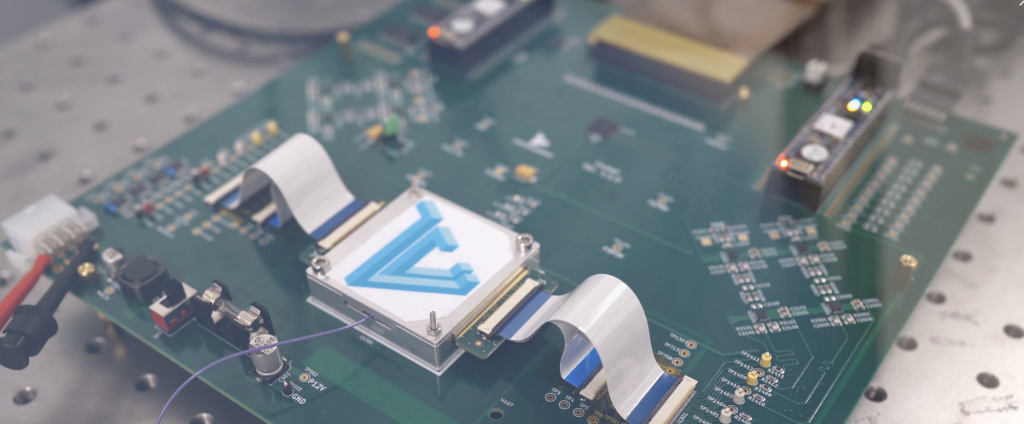
AI hardware startup Lightelligence has raised $319 million in its Hong Kong initial public offering, drawing cornerstone support from Alibaba and Singapore’s sovereign wealth fund Temasek. The IPO marks one of the more significant tech listings in Hong Kong this year and underscores renewed investor interest in AI infrastructure plays, particularly those positioned beyond traditional silicon-based architectures. Cornerstone backing from large institutional investors often provides stability during public listings, especially in sectors characterized by high capital intensity and longer commercialization timelines.
Betting on Photonic Computing
Lightelligence focuses on photonic computing — a technology that uses light instead of electricity to process data. The approach promises lower energy consumption and faster processing speeds compared to conventional semiconductor designs. As AI workloads grow exponentially, energy efficiency has become a critical constraint for data centers. Traditional GPU-based systems, while powerful, require massive energy inputs. Photonic computing startups aim to address this bottleneck by reducing heat generation and latency, potentially offering a more scalable solution for AI inference and training.
The IPO suggests investors are willing to fund alternative chip architectures amid growing compute demand.
Hong Kong’s Bid for Tech Listings
Hong Kong has been working to reassert itself as a destination for technology IPOs, particularly as mainland Chinese firms navigate regulatory shifts and global capital markets recalibrate. Securing a listing from an AI chip startup backed by globally recognized investors strengthens Hong Kong’s position in advanced technology capital formation. The exchange has increasingly courted deep-tech companies, seeking to diversify beyond traditional financial and property listings.
Lightelligence’s IPO aligns with that strategic repositioning.
Strategic Alignment for Alibaba and Temasek
For Alibaba, investment in AI chip startups reflects long-term infrastructure priorities. As cloud computing and generative AI adoption accelerate, access to advanced hardware architectures becomes strategically important. Temasek’s involvement signals sovereign-level confidence in AI as a foundational technology sector. Sovereign wealth funds have increasingly targeted semiconductor and AI infrastructure investments as part of national resilience strategies. Both investors bring patient capital suited to the long development cycles typical in advanced hardware innovation.
Competitive Landscape
The AI chip market is dominated by established players, most notably Nvidia, whose GPUs underpin much of today’s AI training ecosystem. However, energy efficiency and scaling constraints are driving experimentation with new architectures. Startups focused on photonics, neuromorphic computing, and specialized inference chips are competing to carve out niche advantages. Lightelligence’s ability to convert research breakthroughs into commercially viable deployments will determine whether it can compete effectively against incumbent chipmakers.
Market Risks and Execution Challenges
Advanced semiconductor development requires significant R&D investment and long commercialization timelines. Public market investors will scrutinize Lightelligence’s revenue pipeline, partnerships, and deployment milestones closely. Hardware startups face both technological risk and supply chain exposure. Manufacturing precision photonic chips at scale presents engineering challenges distinct from conventional silicon fabrication. However, AI infrastructure demand provides a strong macro tailwind.
What It Signals
Lightelligence’s $319 million IPO highlights sustained capital market interest in AI hardware innovation. With Alibaba and Temasek backing the listing, the company gains credibility alongside funding — critical assets in the capital-intensive semiconductor race. As AI workloads continue to expand, alternative chip architectures may play a pivotal role in shaping the next generation of data center infrastructure. For Hong Kong’s capital markets, the listing reinforces ambitions to become a hub for frontier technology offerings. And for investors, it reflects a broader belief that AI’s next breakthroughs may come not just from algorithms — but from light itself.