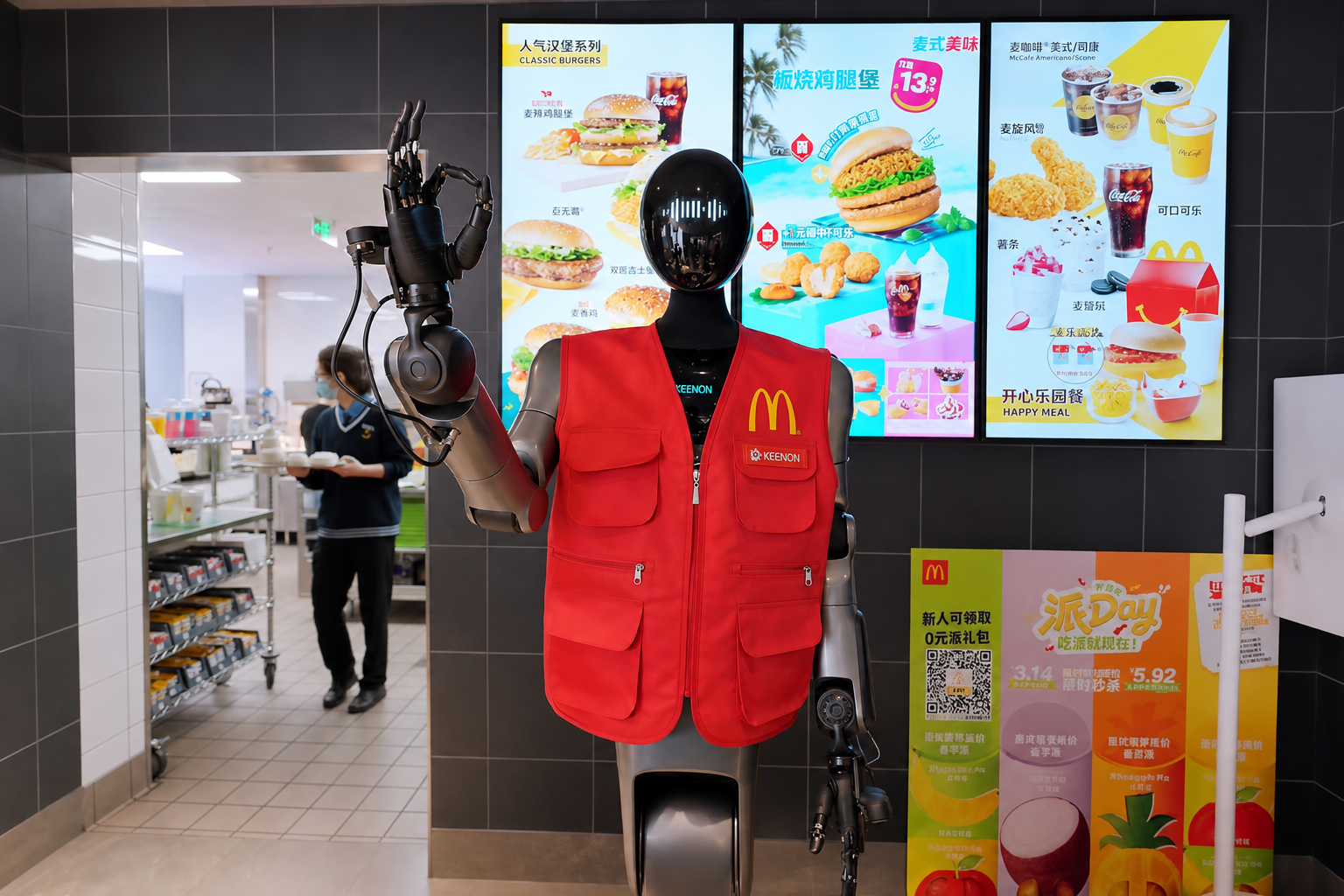
A viral clip of a 'fully automated' McDonald's in Texas is misleading. Discover the reality behind the fast-food giant's current automation efforts and the future of labor.
A viral video purporting to show a fully automated McDonald's in Fort Worth, Texas, is not what it seems. The widely shared clips, suggesting a robot-run restaurant with minimal human staff, paint a misleading picture of the fast-food giant's current automation efforts.
McDonald's, a global titan in quick-service dining, finds itself at the center of an ongoing debate about the future of labor and technology. This latest social media frenzy underscores public anxieties and fascination with AI's role in everyday life, particularly as labor markets tighten and operational costs rise.
The location in question, situated at 5700 North Tarrant Parkway, is indeed a concept store McDonald's calls an "Innovations Lab." Its primary function is a test bed for faster drive-thru and delivery order fulfillment, utilizing specialized conveyor systems and technology, not a completely robot-staffed kitchen.
Despite official clarifications, the video's narrative of robots taking jobs resonated deeply. It illustrated how easily misinformation can shape public perception regarding advanced automation in a high-profile industry.
Across the quick-service restaurant (QSR) industry, automation is a tangible, evolving trend. Companies from Chipotle to White Castle are investing heavily in robotic fryers, AI-powered order taking, and digital kiosks to boost efficiency and address staffing challenges.
The Fort Worth McDonald's, opened in late 2022, was explicitly designed to optimize the experience for customers ordering ahead through the McDonald's app or delivery services. It features a simplified interior with fewer dining tables and multiple drive-thru lanes, including a dedicated lane for mobile orders.
Customers at this "test and learn" location interact primarily with digital kiosks or the mobile app for ordering. Food is then delivered via a conveyor belt system, minimizing direct human interaction at the pickup window.
Crucially, the kitchen itself remains staffed by human employees. They are preparing the food, assembling orders, and managing the overall operation, albeit with technological assistance to streamline their workflow.
This nuanced reality contrasts sharply with the viral video's portrayal of robots flipping burgers or pouring drinks. Those tasks still require human dexterity and oversight in this specific concept store.
The confusion likely stems from the deliberate design to make the customer journey as automated as possible from order placement to final delivery. The visual of a conveyor belt delivering a bag of food creates a powerful, if incomplete, impression of full automation.
For McDonald's, the investment in such a lab reflects a strategic push towards operational efficiency and a response to shifting consumer habits. Mobile ordering and delivery have exploded, demanding faster, more precise fulfillment.
Labor costs, particularly in North America, also play a significant role. With minimum wages on the rise and persistent staffing challenges, technology offers a path to reduce reliance on manual labor for repetitive tasks.
However, the narrative of "robots taking jobs" often oversimplifies the actual integration of automation. Many roles are augmented, not replaced, shifting human workers to tasks requiring more complex problem-solving, customer service, or oversight of the technology itself.
Tech investors and founders in the QSR space understand this distinction. Full-stack robotic kitchens, while aspirational, are still largely in early development or limited commercial deployment, facing immense technical and economic hurdles.
Companies like Miso Robotics, with its Flippy fry cook robot deployed at some White Castle locations, represent a more realistic incremental approach. These robots handle specific, high-volume tasks in the back-of-house, freeing human staff for other duties.
The McDonald's concept in Fort Worth is an evolution of the drive-thru model, not a leap into a fully autonomous restaurant. It’s an optimization play, leveraging existing human labor with new logistical tools.
The company has historically been cautious about broad-scale automation that would fundamentally alter its workforce. Its sheer scale means any significant shift has massive implications for hundreds of thousands of employees globally.
Franchisees, who operate the vast majority of McDonald's restaurants, also face the high capital expenditure of such advanced systems. The return on investment for a complete robotic overhaul is still a distant prospect for most.
Furthermore, consumer preferences remain a factor. While speed is critical, many patrons still value human interaction, especially for custom orders or resolving issues. Purely automated experiences can feel sterile or frustrating when things go wrong.
The viral video served as a powerful, albeit inaccurate, case study in the public's perception of technological progress. It highlighted the gap between what is technically feasible today and what is sensationalized online.
For TechCrunch readers, this isn't just about McDonald's; it's a lesson in the current state of automation. Real-world implementation is often piecemeal, focused on specific bottlenecks, rather than wholesale replacement.
That said, the direction is clear. McDonald's and its peers will continue to integrate more technology into their operations. The Fort Worth location is an early glimpse into a more digitized, streamlined future for fast food.
The true "robot restaurant" remains more science fiction than immediate reality, but the industry is undeniably on a path towards greater technological integration. Expect more sophisticated, yet still human-supported, systems to emerge.
The ongoing challenge for these industry giants is to navigate this technological transition responsibly, balancing efficiency gains with the significant social and economic impacts on their vast workforces.
So, while the Fort Worth McDonald's does push the envelope on automated order fulfillment, the viral videos have significantly overstated its robotic capabilities. It's an innovation lab, yes, but not the robot revolution some claim.
The future of fast food will be automated, but it’s a slow, incremental process, not a sudden robot takeover, requiring careful navigation of technology and public sentiment for successful widespread adoption.
Frequently asked questions
What is the viral McDonald's robot video about?
The viral video falsely depicts a McDonald's in Fort Worth, Texas, as being fully automated with minimal human staff. It suggests an advanced robotic system handling all orders and food preparation, which is not an accurate representation of the restaurant's current operations or McDonald's automation strategy.
Is the Fort Worth McDonald's fully automated?
No, the McDonald's in Fort Worth, Texas, is not fully automated despite viral claims. While it features some automated elements, it still employs human staff for various tasks.
What kind of automation does McDonald's currently use?
McDonald's uses various forms of automation like self-order kiosks, automated beverage dispensers, and some kitchen equipment, but it is not near full automation for an entire restaurant.
Why did the McDonald's robot video go viral?
The video went viral due to its sensational portrayal of a fully robot-run restaurant, tapping into public curiosity and anxieties about the future of labor and technology.
What is McDonald's stance on automation?
McDonald's explores automation to improve efficiency and customer experience but emphasizes that human employees remain crucial to their operations.
Where did the misleading robot video originate?
The video originated on social media platforms, showing what appears to be a highly automated McDonald's concept, but misrepresenting its actual operational level.