Apple's next AirPods merge discreet audio with visual capture, navigating the tension between personal intimacy and AI-driven insights.
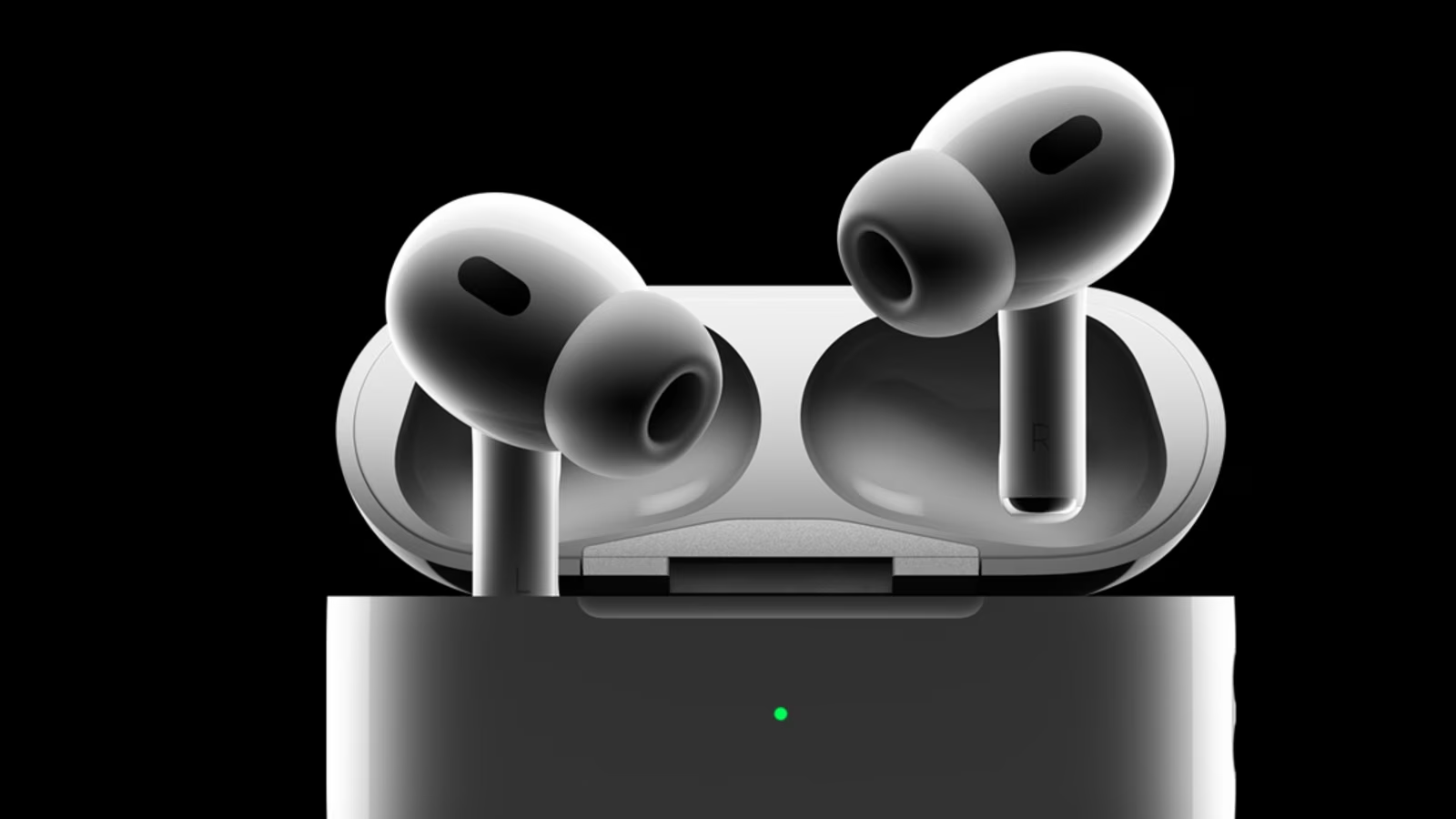
The quiet intimacy of AirPods, long a hallmark of personal audio, stands in stark contrast to the often-perceived invasiveness of cameras. This tension, between unobtrusive sonic immersion and pervasive visual capture, forms the crucible from which Apple's next great paradigm shift may emerge. For years, AirPods have represented a pinnacle of discreet, ubiquitous technology, a personal audio bubble in a cacophonous world. Now, whispers from Cupertino suggest a radical evolution: Apple readies camera-equipped AirPods for an AI push, poised to transform them from mere audio devices into potent, always-on sensory hubs for ambient intelligence.
This isn't a simple feature addition; it represents a strategic pivot, a foundational re-engineering of how we interact with our digital and physical environments. For founders and operators, this anticipated move by Apple signals not just a new product category, but a profound redefinition of user expectations, data modalities, and the very fabric of personal computing. The core conflict lies in reconciling the desire for seamless, intelligent assistance with the inherent privacy concerns of continuous visual monitoring, even if designed for benign purposes. Apple, with its meticulous design ethos and unwavering privacy rhetoric, faces its most significant challenge yet in bridging this chasm.
The Evolution of Ambient Awareness
Since their debut in late 2016, AirPods rapidly transcended mere accessory status to become a cultural phenomenon and a dominant force in the true wireless stereo (TWS) market. With an estimated global market share consistently hovering around 25-30% and generating billions in revenue annually, they established a new benchmark for convenience, connectivity, and audio quality. Yet, their evolution has been largely focused on audio fidelity, active noise cancellation, spatial audio, and improved chip efficiency with the H1 and H2. While accelerometers and gyroscopes enable features like fitness tracking and head tracking for spatial audio, the devices remain fundamentally deaf and blind to their immediate visual surroundings.
The vision Apple is pursuing extends far beyond improved sound. It's about building a comprehensive sensory network around the user. AirPods Pro 2 already incorporate advanced adaptive transparency and conversational awareness, intelligently blending external sounds with audio playback. Adding a camera, however small or low-resolution, introduces an entirely new dimension of real-time environmental input. This isn't merely about taking photos; it's about providing a continuous, contextual stream of visual data to a sophisticated AI, enabling a level of ambient awareness previously confined to science fiction.
The AI Imperative: A New Modality for Intelligence
Apple's recent 'Apple Intelligence' announcement underscored a renewed, aggressive push into generative AI, emphasizing on-device processing for privacy and personalization. While large language models (LLMs) and diffusion models have captivated the tech world, their effectiveness is intrinsically tied to the quality and breadth of their input. Siri, for all its improvements, has remained largely constrained by auditory input and a limited understanding of real-world context. A truly intelligent, proactive AI assistant requires more than just voice commands; it needs to see, understand, and interpret the user's environment.
This is where camera-equipped AirPods become critical. Imagine an AI that not only hears your request but also sees what you're looking at. Pointing at a landmark in a foreign city and asking, "What's that called?" or glancing at a menu and asking, "What's the best option here?" becomes a seamless, natural interaction. The camera serves as the AI's 'eyes,' providing crucial visual context that enriches prompts and enhances the accuracy and utility of responses. It transforms the AI from a reactive command processor into a genuinely ambient, context-aware companion. This shift is fundamental to unlocking the next generation of AI applications, moving beyond mere chatbots to intelligent agents deeply embedded in our daily lives.
Engineering Marvels and Privacy Minefields
Integrating cameras into the diminutive form factor of AirPods presents formidable engineering challenges. Miniaturization, power efficiency, and thermal management are paramount. Apple's silicon expertise, honed through its A-series, S-series, and H-series chips, will be crucial in developing custom, ultra-low-power camera modules and dedicated neural engines capable of processing visual data on-device without significant battery drain or overheating. The goal isn't high-resolution photography, but efficient, continuous data capture for AI inference.
However, the technical hurdles pale in comparison to the privacy and ethical considerations. A wearable camera, even one intended for AI input rather than explicit photo/video capture, evokes immediate concerns about surveillance, consent, and data security. Apple's long-standing commitment to privacy will be tested like never before. Transparency about how data is captured, processed, and stored will be non-negotiable. User control, explicit opt-ins, and clear visual indicators when the camera is active will be essential to building trust. Regulatory bodies globally, particularly in Europe with GDPR, will scrutinize such a product intensely. Apple must not only engineer a product but also engineer a new social contract around wearable visual computing.
New Paradigms: From Augmented Hearing to Ambient Vision
The potential use cases for camera-equipped AirPods are vast and transformative. They extend far beyond simple audio and information retrieval.
Augmented Awareness: Real-time object identification, facial recognition (with strict privacy controls), navigation cues overlaid onto the real world (via audio or subtle haptics), and real-time language translation that "sees" signs and instantly translates them.
Accessibility: Assisting the visually impaired by describing surroundings, reading text aloud, or detecting hazards. Helping those with hearing impairments by visually identifying who is speaking in a noisy environment.
Contextual Computing: An AI assistant that truly understands your immediate context. Looking at a product in a store could trigger an AI to provide reviews or price comparisons. Observing a task could prompt step-by-step instructions.
Health and Wellness: Advanced posture analysis, gait analysis, fall detection, and even subtle monitoring of facial cues for early detection of stress or fatigue.
Productivity: Hands-free visual note-taking, quick capture of information from whiteboards or documents, and enhanced collaboration in remote work environments where visual context is often lost.
This isn't about competing with the iPhone's camera for high-fidelity photography. Instead, it's about creating an 'ambient vision' stream, a continuous, low-resolution data feed optimized for machine perception rather than human viewing. It's the eyes for an intelligent agent, quietly observing and understanding the world around the user.
Strategic Implications for Founders and Operators
For technology founders and operators, Apple's readiness to launch camera-equipped AirPods is a seismic event. It portends the emergence of an entirely new computing paradigm, one that blurs the lines between wearables, hearables, and augmented reality. The implications are multifaceted:
Firstly, it opens up a vast new frontier for application development. New APIs and SDKs will enable developers to leverage visual context in ways previously impossible. Companies specializing in AI, computer vision, accessibility, and contextual services will find fertile ground for innovation. Imagine apps that provide real-time fashion advice based on what you're seeing, or educational tools that identify objects and provide instant information.
Secondly, it intensifies the competitive landscape for companies like Google, Meta, and Amazon, all of whom are investing heavily in ambient computing and AI. While Meta has explored smart glasses with cameras (Ray-Ban Meta Smart Glasses), Apple's ecosystem integration, privacy focus, and sheer market reach could quickly establish a dominant position for its vision of ambient intelligence. Google's Pixel Buds and Amazon's Echo Buds, while capable, lack the deep integration with an overarching AI strategy that Apple is now clearly articulating.
Thirdly, it necessitates a renewed focus on privacy-by-design principles. Any product or service built atop this new visual data stream must prioritize user consent, data minimization, and robust security. Founders building in this space must anticipate stringent regulatory oversight and high user expectations regarding data governance. The reputational risk of a privacy misstep will be immense.
Key Takeaways
New Computing Paradigm: Camera-equipped AirPods signal a shift from mobile-first to ambient, context-aware computing, creating new markets and user interaction models.
AI-Driven Innovation: The camera provides crucial visual input for Apple's AI, enabling more intelligent, proactive, and personalized assistant capabilities.
Privacy as a Differentiator: Apple's approach to integrating cameras will test and leverage its privacy stance, setting a new benchmark for trust in wearable vision systems.
Ecosystem Expansion: New APIs and developer tools will emerge, fostering a rich ecosystem of apps and services built on ambient visual data.
Strategic Imperative for Founders: Prepare for new user expectations, develop privacy-centric solutions, and identify opportunities in contextual AI, accessibility, and augmented awareness.
Ultimately, Apple's preparation of camera-equipped AirPods for an AI push is not just about a new product; it's about solidifying its position at the vanguard of personal technology's next wave. It's a calculated bet on a future where computing is not confined to screens but seamlessly interwoven into the fabric of our perception. The challenge for Apple, and indeed for the entire industry, will be to deliver this profound utility without compromising the fundamental human right to privacy and control over our personal space. The tension between the intimate and the observed will define the success of this audacious venture, reshaping how we interact with technology and the world around us.
Frequently asked questions
What are camera-equipped AirPods?
Camera-equipped AirPods are rumored next-generation Apple earbuds that integrate visual capture capabilities, likely leveraging AI for enhanced user interaction and environmental awareness. They aim to blend personal audio with discreet visual input.
How will AI be used with camera AirPods?
AI could process visual data from the cameras to offer context-aware audio, real-time translations, object recognition, or even assist with augmented reality experiences, enhancing the user's perception of their surroundings.
What are the privacy implications of camera AirPods?
Integrating cameras raises significant privacy concerns regarding data collection, storage, and potential misuse. Apple would need robust security measures and clear user controls to address these challenges effectively.
When are camera-equipped AirPods expected to be released?
While rumors circulate, Apple has not officially announced a release date for camera-equipped AirPods. Speculation suggests they are part of Apple's longer-term vision for AI and wearable technology.
What benefits could camera AirPods offer users?
Potential benefits include enhanced accessibility features, improved situational awareness, context-sensitive information delivery, and new forms of interactive experiences, all integrated seamlessly with audio.
Will current AirPods models get camera features via update?
No, current AirPods models lack the necessary hardware for camera functionality. Camera features would require entirely new hardware, meaning they would be exclusive to future generations of AirPods.