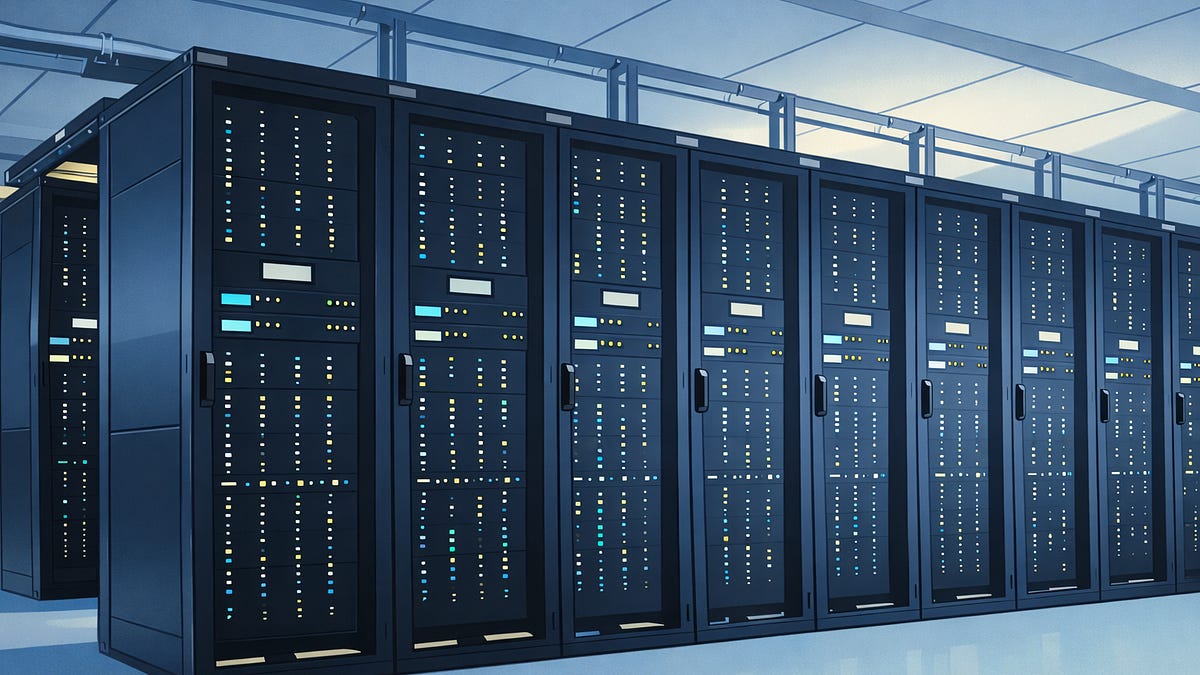
SoftBank's strategic move to develop independent AI infrastructure with industry titans Nvidia and Foxconn signals a major shift in tech autonomy.
In a world increasingly dominated by a handful of hyperscale cloud providers, SoftBank's reported exploration into building its own homegrown AI server infrastructure with industry giants Nvidia and Foxconn isn't merely a strategic investment. It's a profound, almost counterintuitive, declaration of independence. For a company renowned for its asset-light venture capital model, the decision to delve into the capital-intensive realm of physical infrastructure signals a fundamental shift in how global enterprises are approaching the accelerating AI race.
This isn't about mere cost arbitrage or a tactical adjustment to cloud bills. While economics certainly play a role, the deeper imperative for SoftBank and its Vision Fund portfolio companies appears to be strategic autonomy. Relying entirely on Amazon AWS, Microsoft Azure, or Google Cloud Platform for the foundational compute of future AI models introduces vulnerabilities related to data sovereignty, long-term cost predictability, vendor lock-in, and the ability to customize hardware and software stacks at the lowest level for peak performance.
The reported collaboration with Nvidia, the undisputed leader in AI accelerators, and Foxconn, the world's largest contract electronics manufacturer, provides a potent combination of cutting-edge technology and unparalleled manufacturing scale. This triumvirate aims to construct dedicated AI data centers, potentially setting a precedent for other large corporations and investment groups to consider owning their AI destiny rather than merely renting it.
The Strategic Imperative for Homegrown AI
SoftBank's motivation extends beyond typical procurement decisions. Its vast ecosystem of AI-centric companies, ranging from robotics to generative AI startups, represents an immense, continuous demand for computational power. Centralizing this demand onto a custom-built infrastructure offers several compelling advantages.
Firstly, strategic control and data sovereignty. In an era where data is the new oil, controlling where and how that data is processed becomes paramount. For global entities operating across diverse regulatory landscapes, a self-owned infrastructure can provide greater assurance regarding data privacy, security protocols, and compliance with local laws, such as Europe's GDPR or China's data export regulations. This is particularly crucial for training large language models (LLMs) and other proprietary AI systems that ingest vast amounts of sensitive information.
Secondly, performance optimization and customization. Hyperscalers offer generalized services, which, while flexible, may not be optimally tuned for every specific AI workload. By designing and building its own servers, SoftBank can tailor the entire stack, from GPU interconnects (like Nvidia's NVLink) to cooling systems and network architecture, to maximize the efficiency and speed of its specific AI training and inference tasks. This level of deep integration can shave critical milliseconds off processing times and improve throughput, translating directly into competitive advantage for its portfolio companies.
Thirdly, cost efficiency at scale. While the initial capital expenditure for building such an infrastructure is substantial, the long-term operational costs for constant, massive AI workloads can be significantly reduced. Avoiding the variable pricing models and egress fees of public clouds can lead to considerable savings over a multi-year horizon, especially as AI adoption scales exponentially across SoftBank's portfolio. The cost savings are often realized through amortizing fixed investments over massive computational output rather than paying per-use premiums.
Fourthly, future-proofing against supply chain volatility. The global semiconductor shortage and geopolitical tensions have highlighted the fragility of complex supply chains. By establishing a direct manufacturing partnership with Foxconn and a close technological alliance with Nvidia, SoftBank is taking steps to insulate itself from potential disruptions, ensuring a more stable and predictable supply of critical AI hardware for its future needs.
The Power of the Alliance: Nvidia and Foxconn
Nvidia's role in this venture is indispensable. Its dominance in the AI chip market, particularly with its H100 and upcoming Blackwell GPUs, makes it the de facto standard for high-performance AI compute. The company's CUDA software platform and extensive developer ecosystem further solidify its position, providing the foundational technology layer for SoftBank's ambitions. Nvidia's strategic shift from merely selling chips to enabling full-stack AI solutions aligns perfectly with SoftBank's initiative.
Foxconn brings its unrivaled manufacturing prowess to the table. As the primary assembler for much of the world's electronics, Foxconn possesses the scale, expertise, and supply chain management capabilities to mass-produce complex server systems. Its ability to integrate components, manage logistics, and ensure quality control at scale is critical for transforming Nvidia's designs into tangible, deployable hardware. This partnership further diversifies Foxconn's business beyond traditional consumer electronics, pushing it deeper into enterprise and AI infrastructure.
Implications for the AI Landscape
The ripples from SoftBank's initiative will extend far beyond its own operations. This model could inspire other large corporations, national entities, or even rival investment groups to consider similar strategies. The implications are multi-faceted:
For hyperscale cloud providers, this represents a potential challenge to their dominance. While they will continue to serve a vast market, the emergence of large, dedicated private AI clouds could lead to a segmentation of the market. Hyperscalers might respond by offering even more specialized AI services, more flexible pricing models, or greater customization options to retain their most demanding customers.
For the semiconductor industry, it further entrenches Nvidia's leading position while also creating opportunities for other component suppliers. The demand for memory, networking gear, and power management solutions for these custom AI servers will be immense. It also highlights the growing importance of co-design and deep collaboration between chipmakers and system integrators.
From a geopolitical perspective, the drive for "homegrown" AI infrastructure aligns with broader trends of technological nationalism and data sovereignty. Countries like those in the European Union, with initiatives like GAIA-X, are already exploring regional data infrastructure to reduce reliance on foreign tech giants. Similar efforts are underway in various parts of Asia and the Middle East, underscoring a global push for greater control over critical digital infrastructure. SoftBank's move, while commercial, taps into this macro-trend.
Challenges and the Path Forward
Building and operating a hyperscale-grade AI data center is no small feat. The challenges are significant:
The upfront capital expenditure is staggering, requiring massive investment in real estate, power infrastructure, cooling systems, and networking. The ongoing operational complexity of managing such an environment demands a highly specialized workforce for maintenance, optimization, and security. Attracting and retaining top-tier AI infrastructure engineers, data center architects, and cybersecurity experts is a constant battle.
Furthermore, the rapid pace of technological obsolescence in AI hardware means that continuous investment in upgrades and replacements is necessary to maintain a competitive edge. What is cutting-edge today might be outmoded in three to five years. SoftBank will need a robust strategy for hardware refreshes and future-proof design.
Despite these hurdles, SoftBank's track record under Masayoshi Son has always been characterized by bold, long-term visions and a willingness to make massive bets on foundational technologies. From early investments in internet infrastructure to its pivotal role in ARM Holdings, SoftBank has consistently sought to position itself at the core of the "information revolution." This AI server initiative appears to be another such foundational bet, aiming to build the very bedrock upon which its future AI empire will stand.
The collaboration is more than just an attempt to save money on cloud bills; it’s a strategic pivot towards vertical integration in the AI stack. It signifies an understanding that in the coming decades, control over the underlying AI compute infrastructure will be as critical as control over data or algorithms. SoftBank is not just investing in AI companies; it's investing in the very means of AI production.
Key Takeaways
SoftBank's move to build homegrown AI servers with Nvidia and Foxconn signifies a strategic push for autonomy, not just cost savings.
The initiative aims to gain greater control over data sovereignty, customize performance for specific AI workloads, and future-proof against supply chain vulnerabilities.
Nvidia provides the cutting-edge AI accelerators and software ecosystem, while Foxconn offers unparalleled manufacturing scale and integration expertise.
This model challenges the traditional dominance of hyperscale cloud providers and could inspire other large enterprises to develop their own AI infrastructure.
While facing significant capital expenditure and operational complexities, SoftBank's long-term vision positions this as a foundational bet on the future of AI.
Frequently asked questions
Why is SoftBank building its own AI servers?
SoftBank is exploring homegrown AI servers to declare independence from hyperscale cloud providers and shift its strategic focus. This move aims to secure its own infrastructure for future AI endeavors and investments.
Who is SoftBank collaborating with for AI servers?
SoftBank is reportedly collaborating with industry giants Nvidia and Foxconn to build its homegrown AI server infrastructure.
What does 'homegrown AI servers' mean?
Homegrown AI servers refers to SoftBank developing and owning its own artificial intelligence computing infrastructure, rather than relying solely on external cloud services or off-the-shelf solutions.
How does this impact hyperscale cloud providers?
SoftBank's move challenges the dominance of hyperscale cloud providers by signaling a desire for greater autonomy and control over its AI infrastructure, potentially influencing other large enterprises to consider similar strategies.
What is Nvidia's role in this collaboration?
Nvidia, a leading AI chipmaker, would likely provide its advanced GPUs and AI platforms, crucial components for the high-performance computing required by SoftBank's AI servers.
What is Foxconn's role in this partnership?
Foxconn, a major electronics manufacturer, would likely be responsible for the manufacturing and assembly of the physical AI server hardware, leveraging its extensive supply chain and production capabilities.