Discover how brake-by-wire tech revolutionizes automotive stopping power, decoupling your pedal for a safer, more responsive drive.
For over a century, the brake pedal has been a bastion of mechanical certainty in the automotive world. A direct, hydraulic link translating foot pressure into stopping force. This fundamental interaction, however, is on the cusp of a profound transformation. A new generation of braking technology, broadly known as brake-by-wire, is decoupling the pedal from its traditional mechanical duties, ushering in an era where stopping is governed by sophisticated electronics, not just hydraulics.
This shift is far more than an engineering refinement; it's a foundational change that ripples through vehicle design, manufacturing, user experience, and the entire automotive supply chain. For founders and operators navigating the future of mobility, understanding this paradigm shift is not optional; it's critical for identifying emerging opportunities and mitigating significant disruptions.
The Mechanical Past Meets the Digital Future
Traditional braking systems rely on a master cylinder, hydraulic lines, and calipers or drum brakes. The driver's foot on the pedal directly pressurizes brake fluid, engaging the friction material. It's a robust, proven system, but one with inherent limitations in terms of response time, flexibility, and integration with advanced vehicle controls.
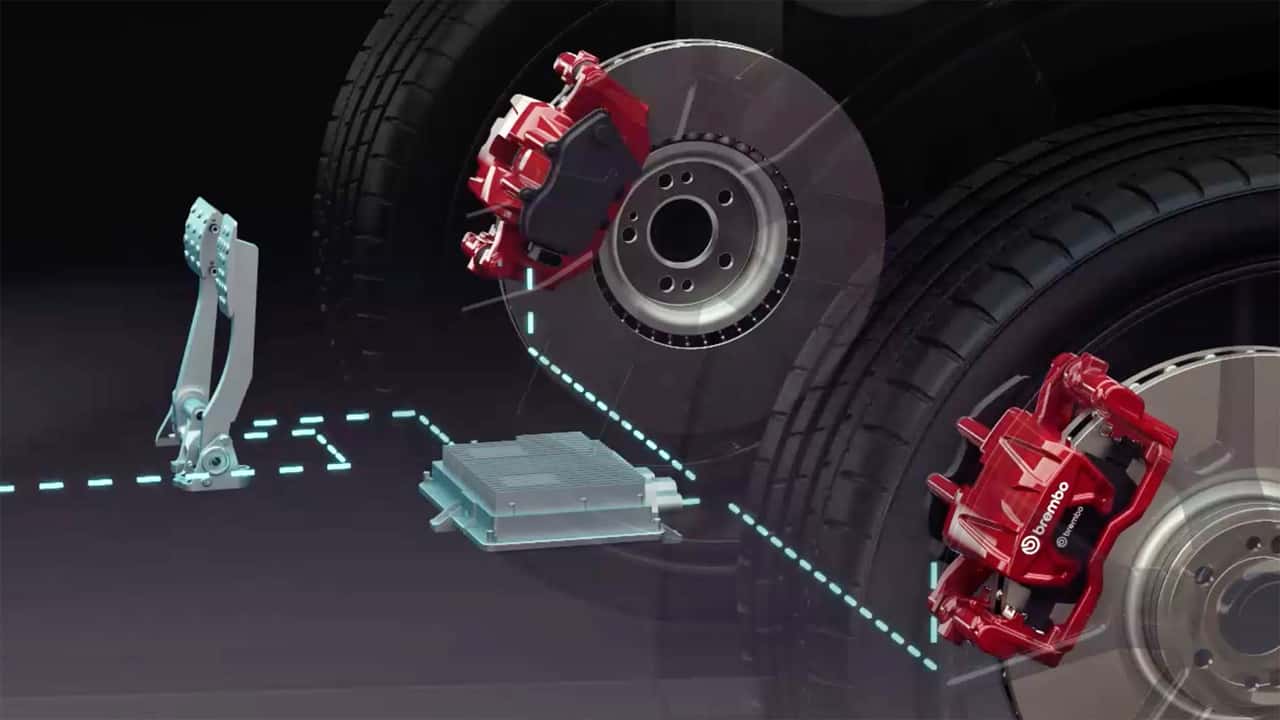
Brake-by-wire systems, primarily electro-hydraulic brake (EHB) systems in current production vehicles and the more advanced electro-mechanical brake (EMB) systems on the horizon, replace this direct mechanical linkage. When the driver presses the pedal, sensors measure the input. This data is then sent to an electronic control unit (ECU) which, based on a complex algorithm, commands electric actuators to apply the brakes. The pedal itself often provides haptic feedback, simulating the traditional feel without a direct mechanical connection to the hydraulic circuit.
The immediate benefits are compelling. Faster response times, typically reducing latency by several milliseconds compared to hydraulic systems, translate directly into shorter stopping distances. The system's ability to precisely control individual wheel braking also enhances stability and steering during emergency maneuvers, moving beyond the capabilities of even the most advanced ABS systems.
For the Founder: Crafting the Next Automotive Staple
The transition to brake-by-wire opens vast avenues for entrepreneurial innovation. Founders are no longer limited to incremental improvements on existing mechanical components. Instead, they can build businesses around the digital control layer, advanced sensor fusion, and sophisticated algorithms that define these new systems.
Consider the market for customizable braking profiles. A performance car owner might desire a firm, immediate pedal feel, while a luxury sedan driver might prefer a softer, more progressive response. Brake-by-wire allows for software-defined pedal characteristics, creating a new segment for specialized software and tuning companies. Startups focusing on predictive braking algorithms, leveraging vehicle-to-everything (V2X) communication to anticipate hazards and pre-charge braking systems, represent another significant opportunity.
The intellectual property landscape is shifting dramatically. Patents are no longer solely on mechanical designs but increasingly on software architectures, control logic, and sensor integration. Founders must strategically build strong IP portfolios around these digital innovations. The supply chain itself presents opportunities for new players specializing in redundant electronic components, high-reliability sensors, and ultra-fast communication protocols, essential for safety-critical by-wire systems. A founder identifying a niche in fail-operational redundancy architectures, for instance, could become a critical supplier to multiple Tier 1 automotive companies.
For the Investor: Calculating the ROI of Disruption
Investors are keenly observing the brake-by-wire sector, which is projected to grow substantially. The global brake-by-wire market, valued at approximately $4.3 billion in 2022, is anticipated to reach over $11 billion by 2030, exhibiting a compound annual growth rate (CAGR) exceeding 13%. This robust growth is fueled by the accelerating adoption of electric vehicles (EVs) and advanced driver-assistance systems (ADAS), both of which heavily leverage brake-by-wire technology.
Market Projection:The global brake-by-wire market is expected to grow from $4.3 billion in 2022 to over $11 billion by 2030, at a CAGR exceeding 13%.
The investment thesis here is multifaceted. Firstly, brake-by-wire is a critical enabler for regenerative braking in EVs. By decoupling the pedal from the friction brakes, the system can seamlessly blend regenerative braking (using the electric motor to slow the vehicle and recover energy) with friction braking. This optimization significantly enhances EV range, a primary concern for consumers. Companies developing superior blending algorithms or more efficient power electronics for this purpose are attracting significant capital.
Secondly, these systems are indispensable for higher levels of autonomous driving (Level 3 and beyond). An autonomous vehicle cannot rely on a human to physically press a pedal; it requires precise, instantaneous, and automated control over braking. Investors are backing companies that can demonstrate robust, safety-certified brake-by-wire solutions integrated with autonomous driving stacks, recognizing that these technologies will form the backbone of future robotaxis and automated logistics fleets.
However, the sector is not without risks. The development costs are substantial, requiring significant R&D investment. Regulatory hurdles, particularly around safety and redundancy for by-wire systems, are stringent. Companies must demonstrate fail-operational capabilities, often requiring triple or quadruple redundancy in critical components. Consolidation among Tier 1 suppliers like Bosch, Continental, and ZF is already evident, but niche players with innovative solutions can still find attractive exit opportunities through acquisition by these larger entities or by becoming direct suppliers to OEMs.
The User Experience: Beyond the Pedal
For the driver, the change is both subtle and profound. The most immediate benefit is often a more consistent and predictable pedal feel, irrespective of vehicle load or brake temperature. As the mechanical linkage is removed, hydraulic fluid compressibility and temperature effects on pedal feel become less relevant, leading to a consistently firm and responsive experience. This consistency can enhance driver confidence and reduce fatigue on long journeys.
Safety is a paramount consideration. By-wire systems can react faster than human reflexes, integrating seamlessly with collision avoidance systems. If an ADAS system detects an imminent collision, it can initiate maximum braking far more rapidly and effectively than a human driver. This electronic precision can shave critical meters off stopping distances, which can be the difference between an accident and a near-miss.
Beyond safety, customization becomes a reality. Imagine a driver being able to select "Comfort," "Sport," or "Eco" braking modes, each offering a distinct pedal response. The "Eco" mode might prioritize regenerative braking for maximum energy recovery, while "Sport" mode delivers immediate, aggressive friction braking. This level of personalization extends the digital experience from infotainment into core vehicle dynamics, making the vehicle feel truly tailored to the individual's preferences. For professional drivers, this could mean optimizing braking for different terrains or loads, enhancing operational efficiency and safety in commercial fleets.
The Analyst's Lens: A Systemic Shift
From an analyst's perspective, brake-by-wire is a foundational technology driving a systemic shift across the automotive industry. It's not an isolated component but a critical enabler for several mega-trends: electrification, autonomous driving, and software-defined vehicles. The move towards centralized vehicle computing architectures, where a few powerful ECUs control multiple domains, benefits immensely from by-wire systems, simplifying wiring harnesses and reducing vehicle weight.
The manufacturing implications are significant. OEMs gain more flexibility in vehicle packaging, as the physical connection between pedal and brake system is no longer a constraint. This can lead to more innovative interior designs, freeing up space in the engine bay or cabin. Production lines will see an increased reliance on software integration and calibration, shifting some of the traditional mechanical assembly processes towards digital configuration.
Supply chain dynamics are also evolving. While traditional brake manufacturers will adapt, there's a growing demand for expertise in electronics, software, cybersecurity, and redundant system design. New specialized suppliers focused on components like fail-safe actuators, high-bandwidth communication buses, and sophisticated control software will gain prominence. Geographically, significant R&D and manufacturing hubs are emerging in Germany (e.g., ZF, Bosch), Japan (e.g., Aisin, Advics), and increasingly in China, where domestic OEMs are rapidly integrating advanced by-wire systems into their EV platforms.
Challenges and the Road Ahead
Despite its advantages, widespread adoption of brake-by-wire faces challenges. Cost remains a significant factor, particularly for entry-level vehicles, as the electronic components and redundancy requirements add complexity and expense. Consumer perception and trust are also critical. The idea of an electronic system controlling such a vital safety function can be a psychological hurdle for some, necessitating robust communication and proven reliability from manufacturers.
Cybersecurity is another major concern. As braking systems become software-defined and networked, they become potential targets for malicious attacks. Developers must implement multi-layered security protocols to prevent unauthorized access or manipulation. The regulatory landscape is continuously evolving to address these new safety and security paradigms, with organizations like UNECE and NHTSA developing new standards for by-wire systems.
The future, however, is undeniably by-wire. As autonomous driving capabilities advance and electric vehicles become ubiquitous, the precision, speed, and adaptability offered by these systems will be indispensable. The brake pedal, as we know it, is evolving from a purely mechanical interface into a sophisticated input device for a highly intelligent, safety-critical subsystem. Founders and operators who grasp the full implications of this shift are best positioned to lead the next generation of automotive innovation.
Key Takeaways
Brake-by-wire technology replaces mechanical linkages with electronic controls, offering enhanced precision, speed, and flexibility in braking.
This shift creates significant entrepreneurial opportunities in software-defined braking profiles, predictive algorithms, and redundant electronic component manufacturing.
For investors, the market is projected to reach over $11 billion by 2030, driven by EV adoption, regenerative braking optimization, and autonomous driving requirements.
Users benefit from improved safety, consistent pedal feel, and customizable braking characteristics, enhancing both performance and comfort.
The technology is foundational for the future of mobility, enabling higher levels of autonomy and advanced vehicle designs, though challenges in cost, perception, and cybersecurity remain.
Frequently asked questions
What is brake-by-wire technology?
Brake-by-wire is an advanced automotive system that replaces the traditional mechanical and hydraulic link between the brake pedal and the braking system with electronic signals. This allows for faster, more precise control and enables new safety and performance features.
How does brake-by-wire change the brake pedal?
It decouples the pedal from direct mechanical duties, meaning the pedal no longer physically actuates the brakes. Instead, it sends an electronic signal to a control unit, which then applies the brakes electronically.
Is brake-by-wire safer than traditional brakes?
Many proponents argue it is safer due to faster response times, more precise braking force distribution, and integration with advanced driver-assistance systems (ADAS) for features like automatic emergency braking.
What are the benefits of brake-by-wire systems?
Benefits include improved responsiveness, better fuel efficiency (especially for hybrids/EVs with regenerative braking), reduced weight, more compact design, and greater flexibility for future autonomous driving features.
Will all new cars have brake-by-wire soon?
While not all cars currently have it, the trend is towards its wider adoption, particularly in electric vehicles and premium segments. It's expected to become more common as technology evolves and costs decrease.
Are there any drawbacks to brake-by-wire?
Potential drawbacks include the complexity of electronic systems, reliance on electrical power (though fail-safe mechanisms are built-in), and the need for robust software and hardware redundancy to ensure reliability.